
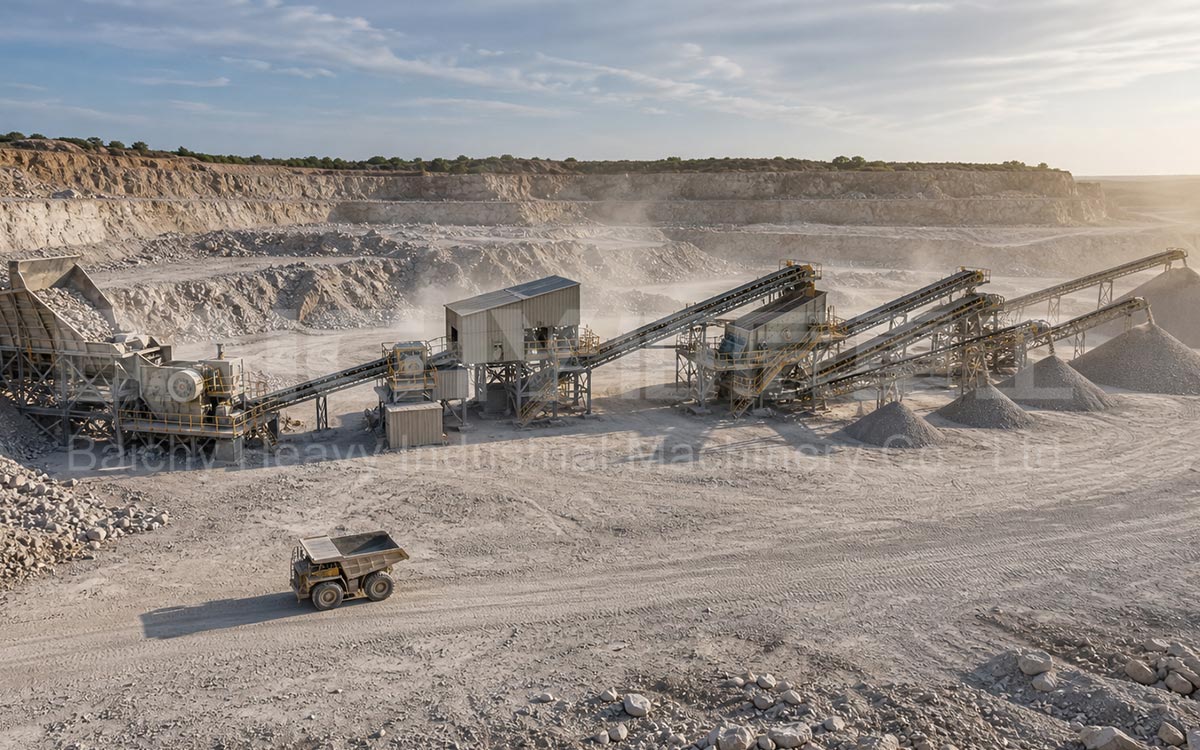
80–100 tph Crushed Stone Production Line Solution
A crushed stone production line with an hourly capacity of 80–100 tons occupies a tricky niche: it is too large for "small-scale" setups yet too small to fully utilize the capacity of "medium-scale" lines. Its most reliable, standard configuration consists of a primary jaw crusher (open-circuit), a secondary impact crusher (for medium-soft materials) or cone crusher (for hard rock), and a closed-loop circuit with a three-deck circular vibrating screen. The difference between these two secondary-stage options lies not in whether they *can* crush the material, but in cost-per-ton, particle shape, and wear-part consumption. By aligning the three key metrics—nominal capacity, feed size, and target gradation—the line can begin generating a return on investment as soon as it enters production.
I. Capacity Positioning: Where the 80–100 tph Crushed Stone Line Fits
This capacity range is subject to three strict constraints, meaning the configuration logic used for large-scale lines cannot simply be copied:
• Primary-stage open-circuit ratio: If the jaw crusher's discharge opening is widened beyond 150 mm, the feed size for the secondary stage will exceed limits; conversely, narrowing the opening yields finer material but causes hourly output to drop sharply. For a line in this capacity class, the primary crushing stage requires a 20–30% capacity margin.
• The secondary stage is the true bottleneck: The actual throughput of impact and cone crushers is heavily influenced by material hardness. While limestone throughput can align with rated values, granite requires a 15–25% reduction (applying a 0.75–0.85 multiplier)—a factor that directly dictates the minimum specifications for the secondary crusher.
• Screening is not a secondary role: Screen surface area must be sized based on "throughput plus recirculating load" rather than just the finished product volume. The recirculation ratio typically falls between 20% and 40%; if the screen is undersized, the output of the entire production line will be throttled by the screening unit.
In summary: Primary crushing sets the upper capacity limit, the secondary stage determines costs, and screening determines actual output.
II. Two Mainstream Aggregate Production Line Solutions
2.1 Solution A | Two-Stage Crushing & One-Screening for Medium-Hard Material (Jaw Crusher + Impact Crusher)
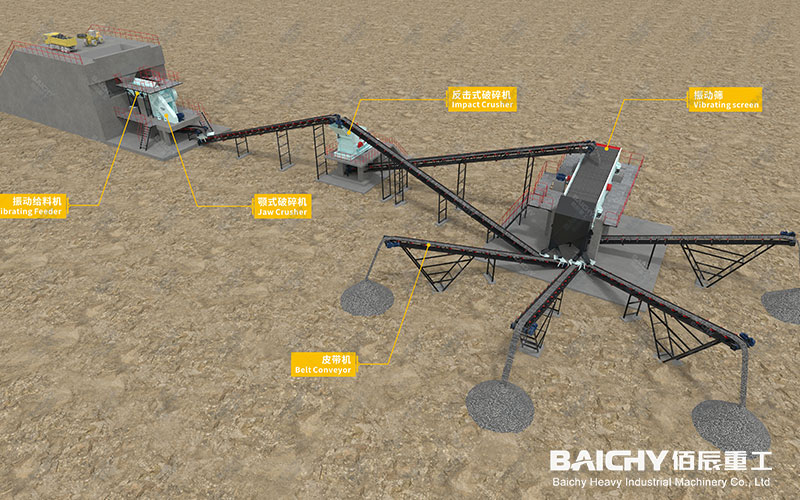
Jaw Crusher + Impact Crusher
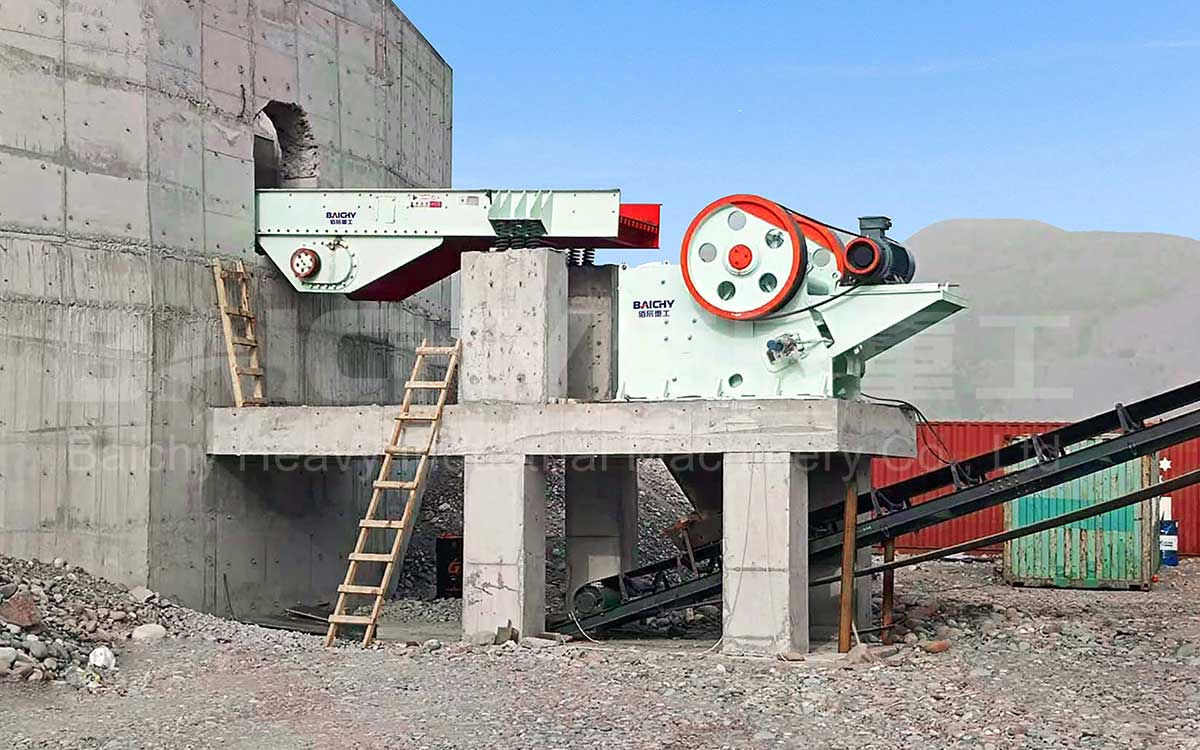
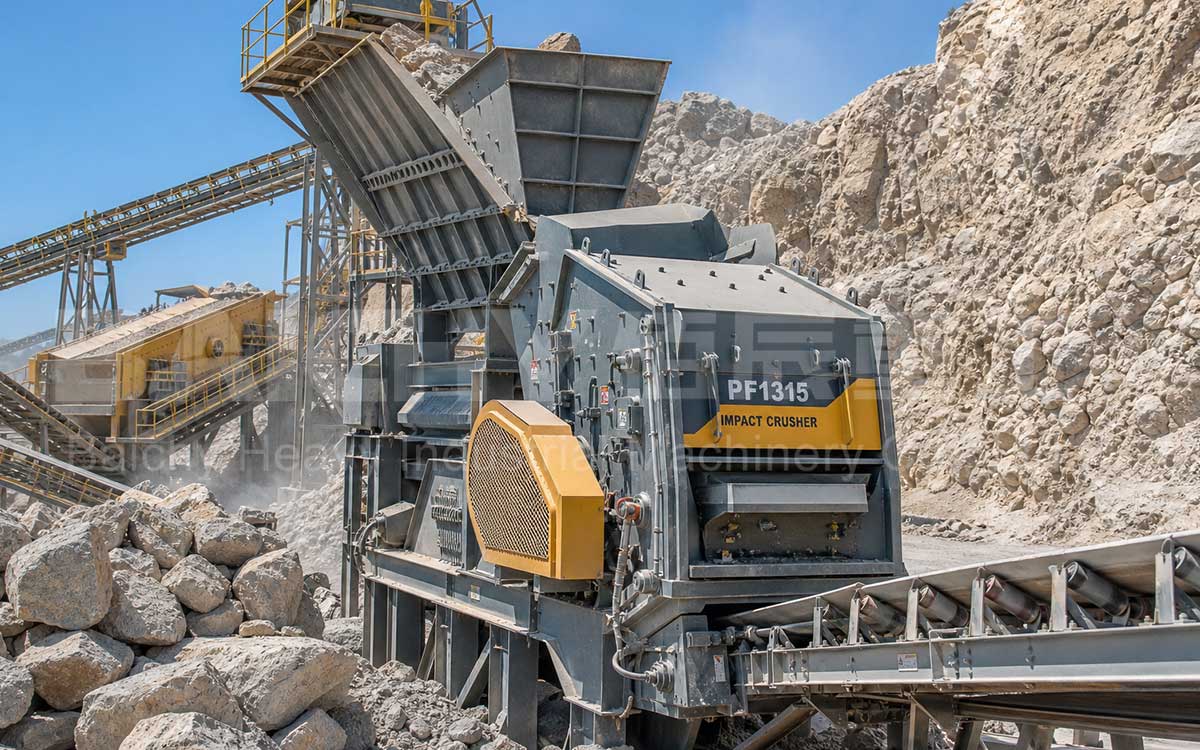
ZSW Vibrating Feeder → PE Jaw Crusher (Primary Crushing) → PF Impact Crusher (Secondary/Fine Crushing) → 3YK Circular Vibrating Screen (Closed-Circuit) → Finished Product Grading. The impact crusher utilizes an "impact and rebound" crushing mechanism, yielding a high proportion of cubical particles and low levels of elongated or flaky particles, making it ideal for producing commercial concrete aggregate; it also requires the lowest equipment investment of the two options.
2.2 Solution B | Two-Stage Closed-Circuit Crushing for Hard Rock (Jaw Crusher + Cone Crusher)
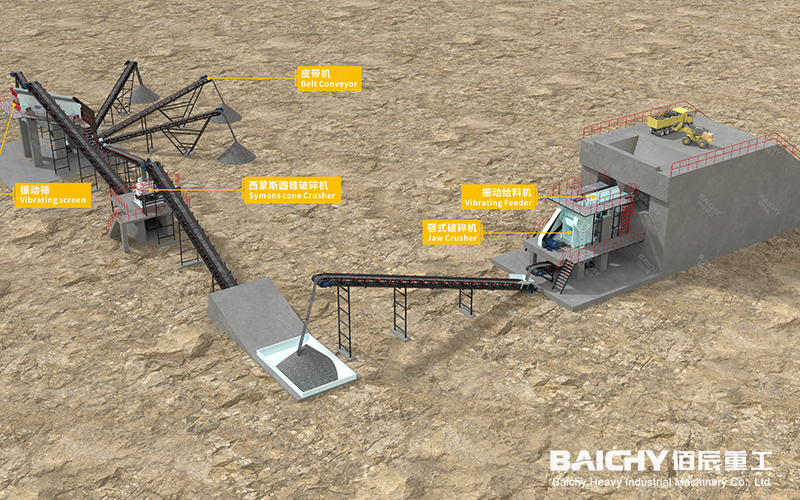
Jaw Crusher + Cone Crusher
ZSW Vibrating Feeder → PE Jaw Crusher (Primary Crushing) → Cone Crusher (Secondary/Fine Crushing) → Three-Deck Screen (Closed-Circuit with Material Recirculation) → Finished Product Grading. Cone crushers employ inter-particle (lamination) crushing; wear-part consumption is significantly lower than that of impact crushers, resulting in lower per-ton costs over the long term. The trade-offs are a 20–30% higher initial investment and greater sensitivity to feed uniformity.
2.3 Side-by-Side Comparison of the Two Schemes
Comparison Item Scheme A: Jaw Crusher + Impact Crusher Scheme B: Jaw Crusher + Cone Crusher
| Comparison Item | Plan A: Jaw + Impact Crusher | Plan B: Jaw + Cone Crusher |
|---|---|---|
| Suitable Materials | Limestone, dolomite, shale (compressive strength ≤150 MPa) | Granite, basalt, river pebbles (compressive strength 150–320 MPa) |
| Product Particle Shape | High cubicity, low flake/elongation ratio | Slightly inferior shape; can be improved by adding a shaping stage |
| Initial Equipment Investment | Lower | Higher (by approx. 20–30%) |
| Wear Part Cost per Ton | Medium-high (rapid blow bar consumption) | Low (long mantle/concave liner lifespan) |
| Feed Uniformity Requirement | Moderate | High |
| Suitable Applications | Commercial aggregate, direct supply to mixing plants | Hard rock quarries, high-quality graded aggregates |
III. Crushed Stone Production Line Equipment Configuration and Key Parameters
| Process | Equipment | Model | Key Parameters | Motor Power | Applicable Scheme |
|---|---|---|---|---|---|
| Feeding | Vibrating Feeder | ZSW-380×96 | Trough 3800×960 mm; max feed ≤500 mm; capacity 100–160 t/h | 11 kW | A / B |
| Primary Crushing | Jaw Crusher | PE-600×900 | Inlet 600×900 mm; max feed ≤500 mm; discharge opening 65–160 mm; capacity 48–180 t/h | 55–75 kW | A |
| Primary Crushing | Jaw Crusher | PE-750×1060 | Inlet 750×1060 mm; max feed ≤630 mm; discharge opening 80–140 mm; capacity 110–320 t/h | 110 kW | B |
| Secondary/Fine Crushing | Impact Crusher | PF-1210 | Inlet 400×1080 mm; max feed ≤350 mm; capacity 70–120 t/h | 110 kW | A |
| Secondary/Fine Crushing | Spring Cone Crusher | PYB1200 | Max. feed size ≤145 mm; discharge opening 20–50 mm; capacity 110–168 t/h | 110 kW | B |
| Screening | Circular Vibrating Screen | 3YK-1860 | Screen surface 1800×6000 mm; 3 decks; equipped with 5 / 10 / 20 / 31.5 mm mesh | 22–30 kW | A / B |
| Conveying | Belt Conveyor | B650 / B800 | Belt width 650 / 800 mm; configured based on line length and incline angle | — | A / B |
Note: Capacities in the table are calibrated based on medium-hardness limestone. For granite, apply a factor of 0.75–0.85; for basalt, apply 0.70–0.80 to estimate actual operational capacity. For hard rock applications, it is recommended to determine equipment specifications based on the lower end of the adjusted capacity range and to specify both nominal capacity and actual operational capacity in the contract.
IV. How to Adjust Finished Product Gradation: Closed-Loop Screening is the Only Means of Adjustment
The four-grade structure of 0–5 / 5–10 / 10–20 / 20–31.5 mm represents the mainstream configuration for commercial aggregates. There are only two ways to adjust the finished products of this crushed stone production line:
4.1 Changing Screen Mesh: Adjusting the Proportion of Each Grade in Minutes
Replacing a 20 mm screen with a 25 mm screen immediately increases the output proportion of the 20–31.5 mm grade. This is the fastest and most cost-effective method to respond to market changes—the production line can shift the focus of its four-grade output within a single morning shift without modifying any primary machinery.
4.2 Adding a Sand-Making Stage: Increasing the Fine Material Ratio for a 100 t/h Crushed Stone Line
If the proportion of fine aggregates needs to be increased from 25% to over 40%, a sand-making stage (using a VSI vertical shaft impact crusher or a double-roll sand-making machine) must be added. Repeatedly narrowing the crusher discharge opening is not a viable strategy: production output will plummet, and the service life of both jaw plates and impact blow bars will be drastically shortened.
V. Investment Cost Estimation for Crushed Stone Production Lines: Three Key Parameters for the Model
| Cost Parameter | Reference Range | Notes |
|---|---|---|
| Electricity consumption (crushing & screening) | 1.2–1.8 kWh/t | Includes primary crushing, secondary crushing, screening, and conveying; varies based on material hardness and gradation profile. |
| Primary jaw plate lifespan | Limestone: 12–18 months / Granite: 4–8 months | Based on 10 hours of daily operation and standard feeding conditions. |
| Impact crusher blow bar lifespan | 3–6 months | Limestone application; impact crushers are not recommended for hard rock. |
| Cone crusher mantle/bowl liner lifespan | 6–12 months | Granite application; inter-particle (lamination) crushing results in more uniform wear. |
Of these three parameters, the equipment purchase price is a one-time cost, whereas electricity consumption and wear parts affect daily operating costs. This is why hard-rock quarries often opt for cone crusher configurations—which require higher initial investment—after calculating the three-year cost of ownership.
VI. Three Common Pitfalls in Equipment Selection
• Signing contracts based on nominal capacity: Rated capacities are typically based on limestone. If the material is granite but acceptance testing is based on nominal capacity, the buyer bears the responsibility for any shortfall in actual output.
• Sizing screen surface area based solely on finished product volume: Ignoring the volume of recirculating material (oversize return) is the most common configuration error in 80–100 t/h production lines; the result is a scenario where "the crusher has spare capacity, but the screen is completely clogged."
• Comparing only equipment quotes without calculating cost-per-ton: Two quotes might differ by only 10%, yet the cost-per-ton over three years could vary by 25%. Requiring suppliers to provide both CAPEX and first-year OPEX estimates is the most effective way to filter out unprofessional proposals.
These three pitfalls point to a single truth: a crushed stone production line is an integrated system, not merely a list of equipment. Even if inpidual machines are perfectly selected, failure to align capacities across the various process stages will still result in underperformance once operations begin.
VII. FAQ
Q1: How many crushers are required for a crushed stone production line with an hourly output of 80–100 tons?
Two stages suffice: a "jaw crusher + impact crusher" combination for medium-soft materials, and a "jaw crusher + cone crusher" combination for hard rock. A third stage for shaping or sand making is only necessary if there are strict requirements for the finished product's gradation or if the proportion of fine aggregates needs to exceed 40%.
Q2: What are the differences in configuration between granite and limestone crushed stone production lines?
The primary difference lies in the secondary crushing equipment. Limestone has low compressive strength and low abrasiveness, making the impact crusher a cost-effective choice that yields good particle shape. In contrast, granite has high compressive strength (150–320 MPa) and high abrasiveness; using an impact crusher would result in rapidly escalating blow bar wear, so a cone crusher must be used instead. Additionally, the primary jaw crusher should be upgraded to a larger model to ensure sufficient capacity margin for the open-circuit process.
Q3: Can the finished product gradation of a 100 tph crushed stone production line be adjusted at any time?
Yes, but adjustments to the proportions of different size fractions can only be made by changing the screen mesh—a process that takes minutes. If the proportion of fine aggregates (0–5 mm) needs to be significantly increased, a sand-making stage must be added; this cannot be achieved simply by adjusting the crusher's discharge opening.
Baichy Heavy Industry
Baichy Heavy Industry is a high-tech mining equipment company integrating R&D, manufacturing, sales, and after-sales service. Focusing on crushing, grinding, and mineral processing equipment, we provide professional solutions to our customers. We are ISO9001:2015 、certified, and our products include mobile crushing palnts, crawler crushing plant, construction waste crushing plants, jaw crushers, sand making machines, cone crushers, fine crushers, grinding mills, ball mills, etc., all with reliable performance to meet diverse project needs.
Baichy Heavy Industry – Your Trusted Partner
To ensure optimal performance of your equipment, Baichy Heavy Industry offers:
- Professional on-site installation guidance
- Comprehensive operator training
- 24/7 technical support & maintenance services
Our complete after-sales service system guarantees long-term, stable operation of your machinery with minimal downtime.
Protect Your Rights – Only Use Official Channels
To avoid scams and ensure authentic support, contact us exclusively through:
• Official Website: www.baichychina.com
• WhatsApp: +8615093222637
• Email: [email protected]
Your satisfaction is our priority – expect prompt, professional service every time.
(Note: Beware of unauthorized third parties claiming to represent Baichy. Always verify through official contacts.)