
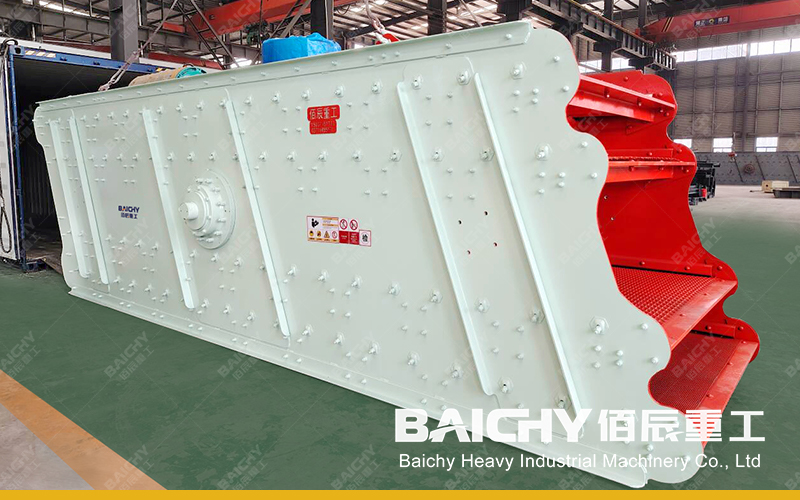
On aggregate processing production lines, vibrating screens act like tireless "sorting masters," their performance directly determining the particle size, purity, and overall production efficiency of the final product. An improperly selected vibrating screen can lead to anything from production bottlenecks and excessive powder content in the product to frequent downtime and soaring maintenance costs.
So, faced with a dazzling array of vibrating screen models on the market, how do you make the wisest choice for your aggregate processing plant? Don't worry, mastering the following five key points will help you find the most reliable "golden partner" for your project.
Key Point 1: Understanding Your "Raw Materials" and "Goals"—Screening Needs Analysis
Before selecting equipment, you must first clearly define your task. This is like a doctor diagnosing a patient before prescribing medication.
1. Raw Material Characteristics:
◦ Material Type: Is it hard, abrasive rocks such as granite and basalt, or moderately abrasive materials such as limestone? The abrasiveness of the material directly determines how "durable" the screen mesh and screen body need to be.
◦ Feed Particle Size and Particle Size Distribution: What is the maximum feed size? Is the fine powder content high? This relates to the screen's load-bearing capacity and anti-clogging design.
◦ Moisture content and mud content: Is the material dry, wet, or sticky? High moisture or sticky materials easily cause screen clogging, requiring special screen cleaning devices (such as bouncing balls, ultrasonic systems).
2. Production goals:
◦ Capacity requirements (tons/hour): This is the core parameter determining the screen size (screen area).
◦ Screening efficiency and product specifications: How high a screening accuracy do you need? How many sizes of final products do you need (e.g., 0-5mm, 5-10mm, 10-20mm)? This determines the number of screen layers required.
Summary: Clearly defining your production needs is the first step to successful selection. Please be sure to prepare a detailed material analysis report and production goals.
Key Point Two: Choosing the Appropriate "Motion Mode"—Vibrating Screen Type
The core of a vibrating screen lies in its motion trajectory; different trajectories are suitable for different screening scenarios.
• Circular Vibrating Screen: Material moves in a circular motion on the screen surface. Suitable for pre-screening after coarse and medium crushing, with a large throughput, especially adept at handling large, highly abrasive materials (such as products after primary crushing). Robust structure, it is a mainstay in aggregate production.
• Linear Vibrating Screen: Material moves in a straight line forward on the screen surface. Suitable for precise grading, dewatering, and desliming operations after fine crushing. High screening efficiency, suitable for applications requiring precise separation of materials into multiple sizes. Due to its motion trajectory, it is also commonly used for dewatering after aggregate washing.
• Elliptical Vibrating Screen/Banana Screen: Combines the advantages of circular and linear vibration. The inlet section uses circular motion to accelerate material stratification, while the outlet section uses linear motion to improve screening accuracy. Ideal for high-load, high-precision grading and screening of medium and fine materials, effectively improving screen surface utilization and allowing for a more compact design.
How to Choose?
• Primarily for pre-screening or processing large materials? → Circular vibrating screen is preferred.
• Need precise grading into multiple product specifications or dewatering? → A linear vibrating screen is ideal.
• Limited space, high throughput, and high precision requirements? → An elliptical vibrating screen/banana screen may be the best solution.
Key Point Three: Determining the Right Size – Screen Surface Size and Number of Layers
The size of the screening machine directly affects its capacity.
• Screen Surface Area: The principle is "better too big than too small." The screen surface area is the most important factor determining processing capacity. The larger the feed rate, the larger the required screen surface area. If the screen surface area is too small, the material layer will be too thick, and fine particles will not be able to effectively contact the screen, leading to a sharp drop in screening efficiency and accelerated screen wear.
• Number of Screen Layers: Determined by the number of grades you need to separate the material into. For example, if you need to obtain three different specifications of finished products, you usually need at least two screen layers (producing three products).
Key Point Four: Focus on the "Heart" and "Skeleton" – Vibrator and Structure
This is fundamental to the durability of the equipment.
• Vibrator: The "heart" of the vibrating screen. The mainstream choices are vibratory motors and box-type vibrators.
◦ Vibratory motors: Simple structure, easy maintenance, and low cost, making them a common choice for small and medium-sized screening machines.
◦ Box-type vibrators: Generate excitation force through shafts and eccentric blocks, providing stronger power, smoother operation, and excellent durability, making them the first choice for large and heavy-duty applications (such as large granite production lines).
• Screen box structure and side plates: The screen box must be made of high-strength steel, and key connection points should have sufficient reinforcing ribs. The thickness of the side plates is crucial, as it determines the fatigue resistance of the equipment under long-term high-intensity vibration.
Key Point Five: The "Details" That Cannot Be Ignored – Accessories and Manufacturers
Details determine success or failure and also affect long-term operating costs.
• Screen type:
◦ Woven screen: The most widely used, with high open area and good air permeability.
◦ Polyurethane screen plate: Wear-resistant, corrosion-resistant, with good anti-clogging effect, low noise, and long service life, but with a slightly lower open area. Ideal for handling highly abrasive materials or applications requiring wet screening.
• Screen Cleaning Device: For materials prone to clogging, a screen cleaning device is essential, such as bouncing balls (installed below the screen) or a more efficient ultrasonic screen cleaning system.
• Manufacturer Quality and Service: Choose manufacturers with a good reputation and extensive experience. They not only provide high-quality equipment but also professional technical support, rapid spare parts supply, and reliable after-sales service, ensuring smooth production.