
As a mining crushing equipment manufacturer with 20 years of professional experience, we understand that choosing the right ball mill is crucial in the mineral processing process. Among them, dry ball mills and wet ball mills are the two most common grinding equipment, with significant differences in their working principles and application scenarios. This article will combine our years of industry experience to provide a comprehensive analysis of the core differences between the two, helping you make the best investment decision.
In-depth Analysis: More Than Just the Difference of Water
Many customers initially believe that the difference between dry ball mills and wet ball mills is simply whether or not water is used. In reality, this difference of water hides comprehensive differences in design philosophy, system configuration, applicable materials, and ultimate economic benefits. The differences between these two types of equipment stem from a deep adaptation to material characteristics and final product requirements.
Overview of Core Differences
| Comparison Dimension | Dry Ball Mill | Wet Ball Mill |
| Grinding Medium | Material is in a dry state, flowing by airflow or its own gravity | Material is mixed with water (or other liquid) to form a slurry for grinding |
| Structural Features | Equipped with an induced draft device and dust removal system at the discharge end to prevent dust | Equipped with a grate plate or overflow weir at the discharge end for easy slurry discharge |
| Product Form | The final product is a dry powder | The final product is a slurry (requires subsequent dewatering) |
| Core Advantages | No dewatering and drying required, product is directly usable, suitable for water-scarce areas | High grinding efficiency, less dust, less over-grinding |
| Main Disadvantages | High dust control requirements, relatively lower grinding efficiency | Adds a dewatering step, high water consumption |
| Applicable Materials | Water-sensitive materials, products requiring dry powder, cement, coal powder, etc. | Most metal ores (iron, copper, gold), non-metallic minerals with good grindability |
Detailed Comparison and Advantage Analysis
1. Working Principle and System Composition
Dry ball mills operate in a sealed environment, relying on hot air or natural air to move the material. Its system must be equipped with efficient dust removal equipment, such as bag filters, which is crucial for controlling the production environment and meeting environmental protection requirements. Wet ball mills, on the other hand, are a water system, where materials are mixed with water in a specific ratio before entering the cylinder, relying on water flow for transport and discharge. The core of the system consists of pumps, classifiers, and subsequent concentration and dewatering equipment.
2. Grinding Efficiency and Energy Consumption
Under the same specifications and material conditions, the grinding efficiency of wet ball mills is usually higher than that of dry ball mills. This is because the presence of water reduces the adhesion of the material and improves its fluidity, allowing the steel balls to impact and grind the material more thoroughly. Therefore, the energy consumption per unit of product in wet grinding is often lower. However, dry grinding eliminates the need for subsequent large-scale dewatering and drying processes, so the overall system energy consumption needs to be comprehensively evaluated.
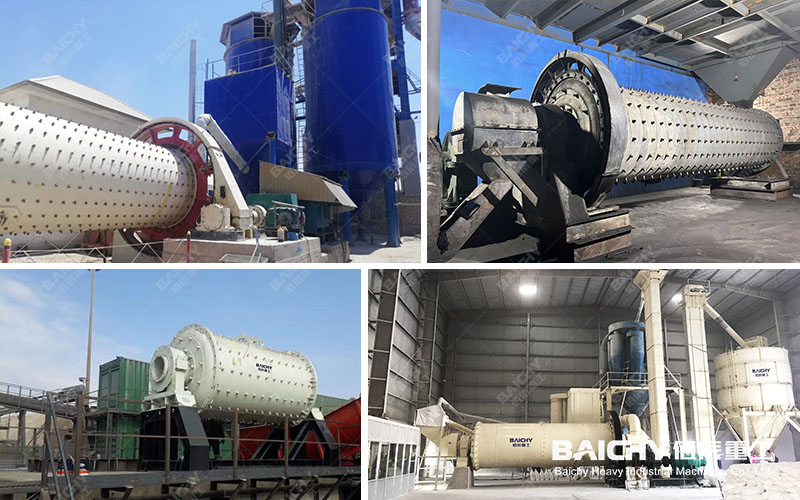
Ball mill customer site
3. Investment and Operating Costs
- Initial Investment: Dry ball mills require additional dust removal and air classification systems, which may result in higher investment costs. Wet ball mills require slurry transportation, classification, and dewatering (such as thickeners and filters) systems, and the overall supporting equipment investment is usually higher.
- Operating Costs: The maintenance focus of dry grinding is on the dust removal system; wet grinding requires consideration of water consumption, wear and tear on pipeline pumps, and dewatering costs. In areas with scarce water resources, wet grinding has a significant operational disadvantage.
4. Environmental Protection and Product Requirements
Dust control is the core of environmental protection for dry ball mills, and improper handling can cause pollution. Wet ball mills are basically dust-free, but they produce wastewater, requiring a supporting water treatment and recycling system. From the product perspective, if the downstream process requires dry powder (such as cement and ceramic raw materials), then dry grinding is the inevitable choice; if it is for flotation, wet smelting, or other wet processes, wet grinding is the better solution.
Practical Application Case Studies
- Case Study 1 (Dry Ball Mill): A large cement plant in North China selected our Φ4.2×13m dry ball mill, equipped with a high-efficiency cyclone dust collector. The limestone, clay, and other raw materials are successfully ground to the required fineness, and the product is directly used in cement production. The system operates stably, and dust emissions are far below national standards.
- Case Study 2 (Wet Ball Mill): A copper mine processing plant in Africa uses our supplied Φ3.6×6.0m wet ball mill and spiral classifier to form a closed-circuit grinding system. It provides qualified pulp for flotation operations, resulting in high grinding efficiency and approximately 15% increase in production line capacity, receiving high praise from the customer.
Equipment Selection Recommendations
When choosing between a dry ball mill and a wet ball mill, please follow these principles:
1. Consider material properties: Dry grinding is suitable for water-sensitive materials and materials that must remain dry; wet grinding is suitable for most metal ores and non-metallic ores that can be wet-ground.
2. Consider process requirements: Does the next process require dry powder or slurry?
3. Consider regional conditions: Wet grinding is preferable in areas with abundant water resources; dry grinding is more suitable in areas with water shortages or severe cold.
4. Consider overall cost: Evaluate the energy consumption and cost of the entire process from grinding to producing the final qualified product.
As an experienced mining crushing equipment manufacturer, we can provide you with free process analysis, equipment selection, and solution design to maximize your return on investment.
Frequently Asked Questions (FAQ)
Q1: Can a dry ball mill be simply modified into a wet ball mill?
A: Not recommended. The structural details (such as discharge device, liner type), sealing requirements, and supporting systems are completely different. Forcing a modification will lead to low efficiency, increased wear, and even equipment damage. Equipment with a dedicated design should be selected based on the requirements.
Q2: What is the approximate water consumption of a wet ball mill?
A: Water consumption is related to material properties and concentration requirements, usually between 60% and 75% grinding concentration. The water consumption per ton of raw ore is approximately 2-5 tons, which needs to be determined through beneficiation tests. Modern processing plants generally have water circulation systems, which can significantly reduce fresh water consumption.
Q3: Which type of ball mill experiences more wear on its liners and steel balls?
A: Generally, when grinding the same material, wet ball mills have a slightly lower wear rate on the liners and grinding balls than dry ball mills due to the lubricating and cooling effect of water. However, wear mainly depends on the material hardness, mill speed, and the material of the grinding media, and requires a case-by-case analysis.
Perfect after-sales service
Baichy Heavy Industry provides professional on-site guidance for installation, training of workers, and other services to ensure that customers can use the equipment smoothly.
The company has a complete after-sales service system, which can provide customers with timely technical support and equipment maintenance services to ensure the long-term stable operation of the equipment.
To prevent the rights and interests of customers from being infringed, Baichy Heavy Industry reminds customers: please contact our customer service staff through the official website of Baichy Heavy Industry , or add WhatsApp: 15093222637 ; or send an email to: [email protected] , we will get in touch with you as soon as possible and provide you with the most professional service in the industry.

Baichy Heavy Industry
Baichy Machinery is a factory supplier of mining machinery, mainly focusing on stone crushers, powder grinding mills, and mineral beneficiation plants. We can offer you a free design and completed solutions according to your project.
Baichy Heavy Industry has grown into a high-tech mining equipment comprehensive enterprise, integrating R&D, manufacturing, sales, and after-sales service, Passing ISO9001:2015 quality management system certifications. The main products are mobile jaw crushing plants, construction waste crushing plants, PE jaw crushers, VSI sand-making machines, Symons cone crushers, single-cylinder hydraulic cone crushers, PCX high-fine crushers, grinding mills, ball mills, and full sets of beneficiation equipment with an excellent level.