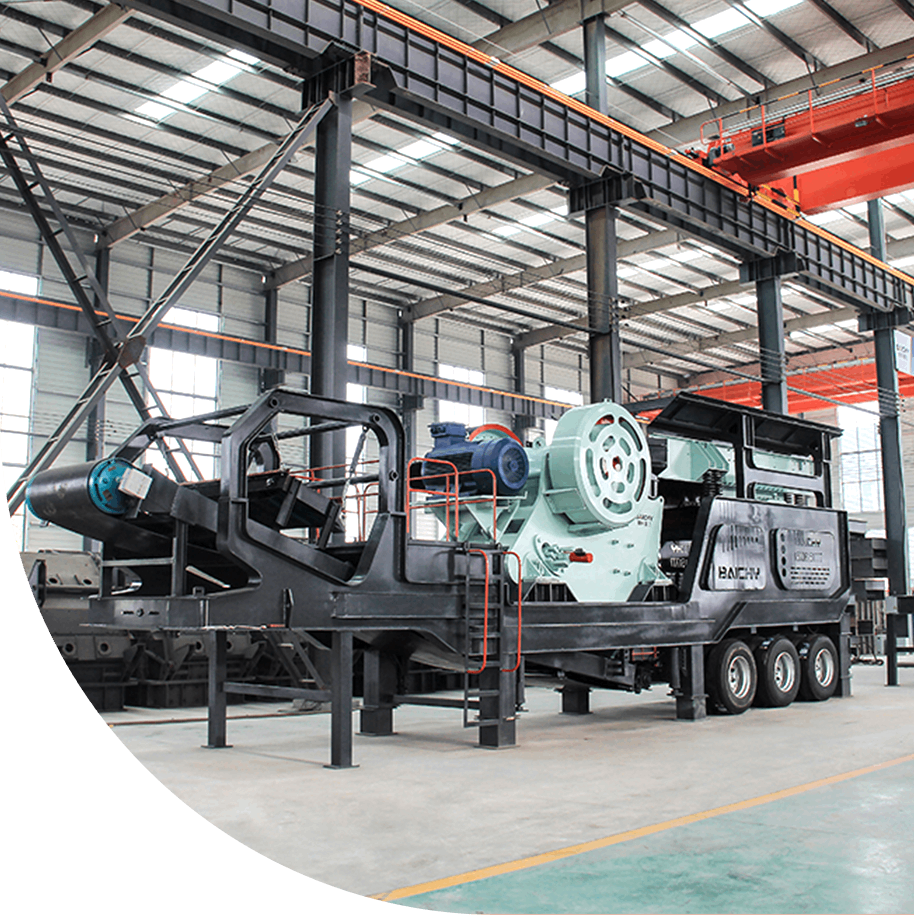

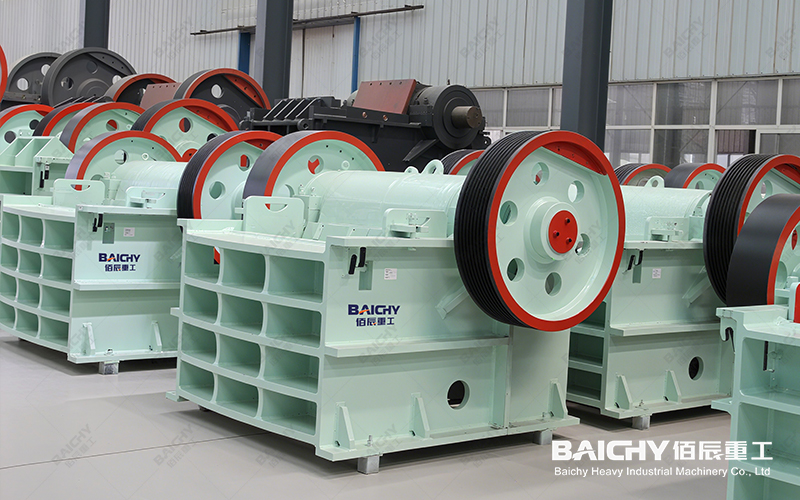
250x1200 Fine Jaw Crusher
The 250x1200 fine-crushing jaw crusher (PEX-250×1200) serves as the "benchmark for cost-effectiveness" in secondary fine-crushing stages for small-scale production lines. It features a 250×1200mm feed opening, a maximum feed size of 210mm, a continuously adjustable discharge range of 25–60mm, and a single-unit capacity of 20–61 t/h. Its value lies not in sheer crushing force, but in stability, cost savings, and operational speed: the investment cost is less than half that of a cone crusher setup with equivalent capacity; maintenance involves simply replacing jaw plates rather than entire assemblies; it allows for independent operation and maintenance even in remote mining areas; and the initial investment can be recouped within three months of commissioning. This article examines the equipment from three perspectives—specifications, operating conditions, and case studies—to explain why it is the ideal long-term choice for medium-to-fine crushing stages.
I. Overview: The Role of the Fine-Crushing Jaw Crusher in Medium-to-Fine Crushing
In a standard crushing production line, primary crushing sets the upper size limit, while fine crushing determines the final product gradation. After a primary jaw crusher reduces raw material to 100–300mm, medium-to-fine crushing equipment takes over to further reduce the particle size to the required product specifications. Currently, small-scale aggregate quarries and mineral processing plants assign this stage to one of three types of equipment: cone crushers, impact crushers, or fine-crushing jaw crushers. Among these, the fine-crushing jaw crusher has long been underestimated; many industry professionals associate jaw crushers solely with primary crushing, overlooking the structural advantages of the PEX fine-crushing series in the 20–60 t/h capacity range.
The 250x1200 model belongs to the PEX fine-crushing series. While it shares the same inter-particle (lamination) crushing principle as the primary PE jaw crusher, it features a flatter, elongated feed opening and a higher reduction ratio, making it specifically suited for the secondary crushing stage—taking feed material sized 100–210mm and reducing it to a discharge size of 25–60mm. For production lines with an hourly output of 20–60 tons, it serves as either the primary unit for the secondary crushing stage or as a pre-crusher for a cone crusher, ensuring the medium-to-fine crushing process maintains the core advantages of structural simplicity, fewer potential failure points, and rapid maintenance.
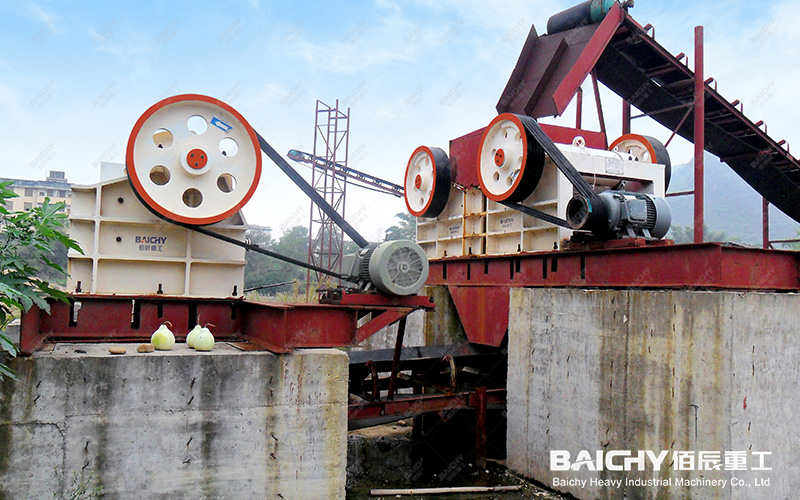
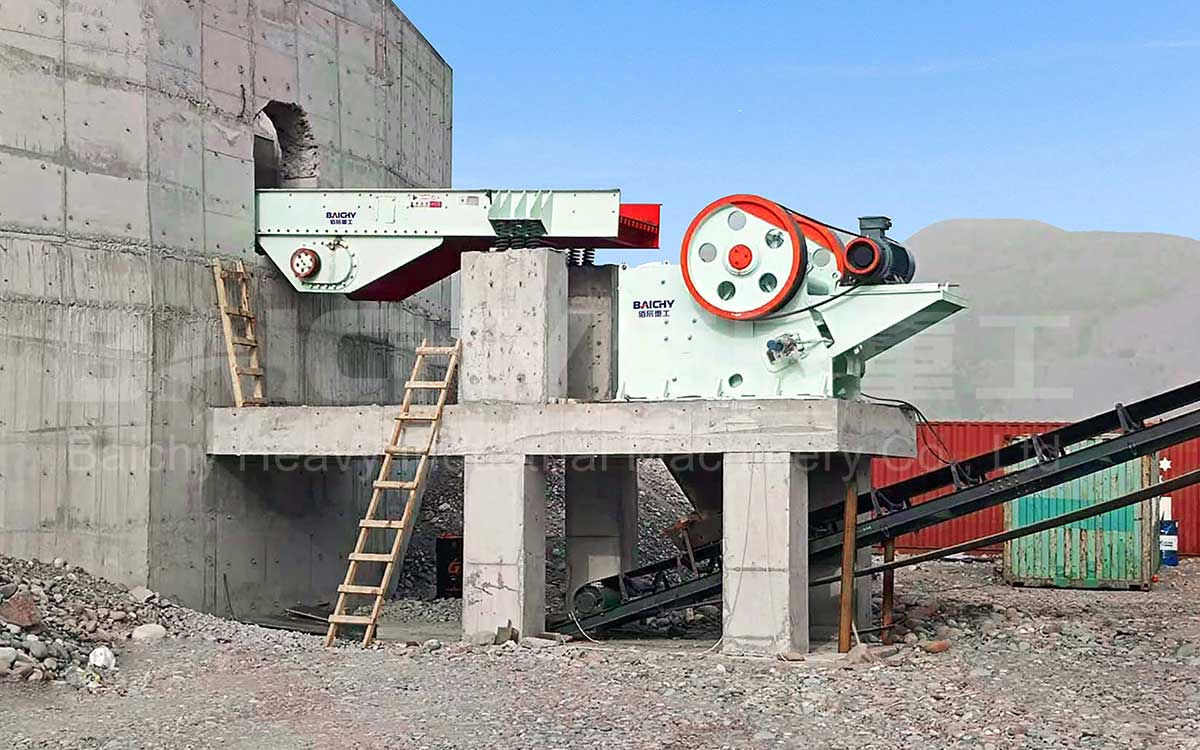
Fine Jaw Crusher Customer Site
II. Core Specifications
| Parameter | Specification |
| Equipment Model | PEX-250×1200 (Fine Jaw Crusher) |
| Feed Opening Dimensions | 250 × 1200 mm |
| Max. Feed Size | ≤210 mm |
| Discharge Opening Adjustment Range | 25–60 mm (continuously adjustable) |
| Processing Capacity | 20–61 t/h |
| Eccentric Shaft Speed | 330 r/min |
| Motor Power | 37 kW (6P; 55 kW optional) |
| Material Compressive Strength | ≤320 MPa |
| Crushing Principle | Laminated crushing (swing jaw compression) |
| Typical Applications | Secondary crushing for aggregates; medium-to-fine crushing in mineral processing; construction waste recycling; pre-crushing for grinding |
Note: Capacity is rated based on limestone (density 1.6 t/m³); actual capacity for granite is calculated by multiplying by 0.8–0.9, and for iron ore by 0.7–0.8. Discharge size is controlled by adjusting the discharge opening; a 10–15% margin is recommended for equipment selection.
III. Application Scenarios
3.1 Secondary Crushing in Small-Scale Aggregate Lines
For aggregate plants with an hourly output of 20–60 tons, a standard "two-stage crushing plus screening" line is formed using a PE primary jaw crusher and the PEX-250×1200 fine jaw crusher. Coarse crushed material (100–210 mm) is fed directly into the fine jaw crusher; the output (25–60 mm) goes to a vibrating screen for classification into 0–5 mm and 5–25 mm fractions, suitable for direct supply to concrete mixing plants and highway sub-base layers. The entire line requires minimal civil engineering and a small footprint, making it ideal for startup quarries with limited capital and space, as well as for "phased investment" models (starting production now and expanding later).
3.2 Pre-stage Medium-to-Fine Crushing in Mineral Processing Plants
Mineral processing operations for gold, copper, manganese, and other ores require uniform feed size and low fines generation prior to the grinding stage. The fine jaw crusher produces a stable, controllable output of 25–60mm material. When paired with a closed-circuit screening system, it provides "uniform-size feed" to the ball mill, thereby reducing over-grinding and energy consumption. Saving just 1 kWh in the crushing stage lowers the processing cost per ton at the plant—a direct, practical application of the "crushing instead of grinding" strategy in mineral processing.
3.3 Construction Waste and Concrete Recycling
Construction waste often contains rebar and brick-concrete fragments; impact-type crushers are prone to tooth damage and material jamming in such conditions, whereas the jaw structure is naturally resilient to iron and impurities. The fine jaw crusher adapts well to materials with high moisture or impurity content. Its output can serve as recycled aggregate for backfill or as raw material for brick-making, making it a highly reliable choice for the secondary crushing stage in urban solid waste resource recovery lines.
3.4 Pre-crushing for Grinding Lines
Raymond mills and ball mills typically require feed sizes of ≤30–50mm; grinding large, raw chunks directly results in high electricity consumption and excessive wear. Using a fine jaw crusher to reduce ore to 25–60mm before grinding significantly boosts the mill's hourly output and reduces wear—offering grinding plants one of the best energy-saving upgrades in terms of return on investment.
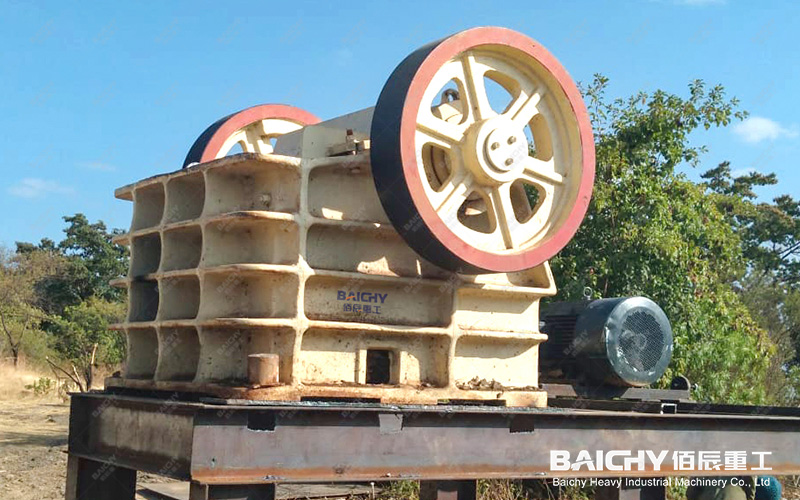
250x1200 fine jaw crusher
IV. Equipment Advantages
4.1 Elongated Feed Opening for High Intake Capacity
The 250×1200mm flat feed opening ensures even material distribution within the crushing chamber, preventing single-point overloading. It handles flaky or slab-like materials (such as gneiss, shale, or layered limestone) better than models with square feed openings, resulting in a lower risk of jamming.
4.2 Mechanical Discharge Adjustment for Controllable Output
The discharge opening is continuously adjustable between 25mm and 60mm. The wedge-style adjustment mechanism eliminates the need for machine downtime or disassembly, allowing for a switch in production specifications (e.g., graded aggregate, sub-base material, or pre-grinding feed) in just minutes—enabling a single machine to produce multiple types of finished products and maximizing capacity utilization. 4.3 Inter-particle crushing; controllable wear costs
The movable and fixed jaw plates are cast from high-manganese steel, typically offering a service life of 6–12 months in medium-hard rock applications. The jaw plates are reversible and replaced in pairs; the cost per ton for wear parts is significantly lower than that of blow bars in impact crushers (with an even greater advantage in hard rock applications), and spare parts feature short procurement lead times and transparent pricing.
4.4 Simple structure; low maintenance requirements
The system does not rely on hydraulic systems or lubrication stations, and bearings and drive components are standardized, allowing local maintenance personnel to handle routine upkeep. Downtime for maintenance is measured in hours, providing an implicit guarantee of production capacity for continuous processing lines.
V. Real-world Case Studies
Case 1: Small-scale granite aggregate plant in Southeast Asia.
A line with an hourly capacity of 40 tons, featuring a PE-400×600 primary jaw crusher, a PEX-250×1200 fine jaw crusher, and a vibrating screen. Adjusting for granite characteristics (×0.85 factor), the actual capacity is approximately 34 t/h. The 25–40mm output serves as graded aggregate supplied directly to local commercial concrete plants. The project went from contract signing to commissioning in six weeks; the total investment for the line was roughly half that of a cone crusher-based solution of equivalent capacity, and the initial set of jaw plates lasted approximately eight months.
Case 2: Pre-crushing at an African gold processing plant.
Run-of-mine ore (≤210mm) is crushed in a closed circuit by a fine jaw crusher to ≤60mm before entering the ball mill. The proportion of -200 mesh fines increased by approximately 5 percentage points, and mill power consumption dropped by about 12%. The consistent output particle size provided reproducible feed conditions for the CIL (Carbon-in-Leach) process.
Case 3: Construction waste recycling line in Latin America.
Urban demolition waste containing rebar fragments frequently caused jamming in the original impact crushing equipment. After switching to a fine jaw crusher for secondary crushing, monthly downtime decreased by approximately 70%. The output is used for recycled backfill and as raw material for permeable bricks, with a stable production capacity of 25–30 t/h.
VI. Recommended Auxiliary Equipment
| Stage | Recommended Equipment | Notes |
| Feeding | ZSW-380×96 Vibrating Feeder | Uniform feeding; pre-screening to remove soil |
| Primary Crushing | PE-400×600 / PE-500×750 Jaw Crusher | Capacity matched with the fine jaw crusher |
| Fine Crushing (This Unit) | PEX-250×1200 Fine Jaw Crusher | Main unit for secondary crushing |
| Screening | YA Series Vibrating Screen | Closed-circuit circulation for material return |
| Sand Making (Optional) | VSI-7611 Sand Making Machine | Produces manufactured sand alongside aggregate |
| Powder Grinding (Optional) | Raymond Mill / Ball Mill | Material enters the mill after pre-crushing |
VII. FAQ
Q1: What is the hourly capacity of the 250x1200 fine jaw crusher?
Rated capacity is 20–61 t/h (based on limestone at 1.6 t/m³). Actual capacity should be adjusted by a factor of 0.8–0.9 for granite and 0.7–0.8 for iron ore. It is recommended to allow a 10–15% margin during model selection and configure a closed-circuit screening system to ensure stable output gradation.
Q2: How do I choose between a fine jaw crusher and a cone crusher?
Consider capacity and material hardness: For hourly outputs under 50 tons and materials of medium hardness or lower, the fine jaw crusher offers significantly lower investment and maintenance costs. Cone crushers are required for high-volume production lines processing hard rock (>250 MPa) due to their superior capacity and ability to produce finer output. They can also be used in series—fine jaw crusher for pre-crushing and cone crusher for final crushing.
Q3: How often do the jaw plates need replacing?
It depends on material abrasiveness and feed particle size: typically 6–12 months for medium-hard rock applications. Jaw plates are reversible to extend service life; once worn to the limit, they should be replaced in symmetrical pairs. Downtime for a single replacement is approximately 4–8 hours.
Baichy Heavy Industry
Baichy Heavy Industry is a high-tech mining equipment company integrating R&D, manufacturing, sales, and after-sales service. Focusing on crushing, grinding, and mineral processing equipment, we provide professional solutions to our customers. We are ISO9001:2015 、certified, and our products include mobile crushing palnts, crawler crushing plant, construction waste crushing plants, jaw crushers, sand making machines, cone crushers, fine crushers, grinding mills, ball mills, etc., all with reliable performance to meet diverse project needs.
Baichy Heavy Industry – Your Trusted Partner
To ensure optimal performance of your equipment, Baichy Heavy Industry offers:
- Professional on-site installation guidance
- Comprehensive operator training
- 24/7 technical support & maintenance services
Our complete after-sales service system guarantees long-term, stable operation of your machinery with minimal downtime.
Protect Your Rights – Only Use Official Channels
To avoid scams and ensure authentic support, contact us exclusively through:
• Official Website: www.baichychina.com
• WhatsApp: +8615093222637
• Email: [email protected]
Your satisfaction is our priority – expect prompt, professional service every time.
(Note: Beware of unauthorized third parties claiming to represent Baichy. Always verify through official contacts.)