
Baichy Heavy Industrial Machinery Co., Ltd
Phone/Wechat/Whatsapp:+008615093222637
24 hours online

MTW175 Limestone Grinding Production Line: System Configuration, Capacity, and Investment Analysis

2024-05-14 10:45:38
Baichy Heavy Industry
plays
Warm Tip:

If you want to know more details about equipment, solutions, etc, please click the button below for free consultation, or leave your requirements!

MTW175 Trapezium Mill

MTW175 Trapezium Mill

When building a limestone powder production line, the critical piding line lies not in the mill's nominal capacity, but in whether the entire six-stage process—crushing, feeding, grinding, classifying, dust collection, and packaging—is designed around a consistent target fineness. Since limestone has a Mohs hardness of only 3, the ability to grind it is hardly a feat; the real challenge lies in translating the MTW175’s single-unit capacity of 8–15 t/h (at 200-mesh fineness) through the complex interfaces of feeding, airflow, and dust collection, ultimately converting it into shippable, auditable tonnage in the finished product silo. Based on a daily production schedule of 15–20 hours, this line targets a daily output of 120–300 tons and an annual capacity of 40,000 tons—precisely the optimal scale for a medium-sized powder plant to serve a regional market with a single production line.

I. Why "Production Line Thinking" Matters More for Cost-per-Ton Than "Single-Unit Specifications"

Limestone powder is not merely a single commodity; it represents three distinct markets, each with its own acceptance criteria, requiring the production line design to be tiered according to the end-use:

• Power Plant Flue Gas Desulfurization (FGD): Absorbents are accepted at 250–325 mesh with dual controls on particle size and chemical activity; deliveries are batch-based, requiring the production line to ensure "fineness stability" as a systemic capability rather than just a mill-specific one.

• Ground Calcium Carbonate (GCC) Powder: 325–400 mesh grades are used as fillers for plastics, coatings, and rubber; pricing is directly determined by whiteness and particle size distribution, meaning a single instance of batch inconsistency could result in the loss of a long-term client.

• Construction Materials and Steel Mill Flux: 80–200 mesh coarse powders offer the highest sales volume and the most lenient acceptance standards, serving as the production line's capacity backbone and primary source of cash flow.

This leads to the first principle of equipment selection: define the "target fineness × daily production schedule" first, then work backward to determine the production line configuration, rather than simply comparing nominal single-unit outputs. Why is it that the same MTW175 model yields stable daily output for some operators while causing frequent, recurring downtime for others? The answers lie primarily in the production line configuration: if auxiliary equipment is undersized, the main mill is "starved" of feed; incorrect airflow settings cause a drop in fine powder recovery rates; and inadequate dust collection leads to production shutdowns during environmental inspections. While the inpidual mill determines *if* grinding is possible, the production line determines *if* grinding can be done stably and profitably.

II. The Six-Stage Process of a Limestone Grinding Line: Configuration from Crushing to Packaging

The process flow follows the sequence of "controlling particle size first, stabilizing load second, locking in fineness third, and ensuring recovery last." All six stages are essential:

1. Crushing and Feeding Stage: Translating Feed Requirements into Equipment Selection

Feed size (≤ 35 mm) and feed moisture (≤ 5%) are the two strict operational limits for the MTW175; these are ensured by the upstream equipment. A jaw crusher reduces raw ore to ≤ 35 mm, with a vibrating screen acting as a gatekeeper. A storage bin paired with an electromagnetic vibrating feeder ensures continuous, uniform feeding, preventing issues like "dry grinding" (due to feed interruption) or "choking" (due to sudden surges of material). Equipment selection for the feeding stage typically includes a 1.2–1.5x capacity margin relative to the main mill—this serves as the most cost-effective insurance for the entire line.

2. Main Grinding and Classification Stage: Switching Fineness Based on Orders

The main grinding stage consists of the MTW175 Trapezium Mill unit itself. It utilizes an integrated bevel gear drive system—replacing the spring-pressure mechanism found in traditional Raymond mills—to ensure consistent grinding force through structural rigidity, preventing fineness drift during the mid-to-late stages of wear. A built-in variable-frequency turbine classifier allows for seamless switching between 200-mesh construction-grade powder and 250/325-mesh desulfurization powder without stopping the machine or changing parts. For structural details of the mill, please refer to the "MTW175 Trapezium Mill for Limestone Grinding" product page; here, we emphasize only one point: the capacity rating of the main grinding stage must be synchronized with the airflow and dust collection capabilities of the entire line.

3. Dust Collection, Conveying, and Packaging Section: A Negative-Pressure Closed-Loop System Determines Environmental Compliance and Per-Tonne Costs

A negative-pressure closed-loop system—comprising a cyclone dust collector and a pulse-jet bag filter—ensures complete recovery of fine powder and emissions compliance; these two factors directly determine whether the facility passes environmental inspections. Finished product silos pert material based on grade, and packaging machines accommodate both bulk bags and valve bags, minimizing losses from secondary handling. A centralized forced-circulation thin-oil lubrication station keeps bearing temperature rise under control, transforming reactive emergency repairs into scheduled maintenance—this is the true source of confidence for long-term, continuous production, not the specifications on the main unit's nameplate.

Schematic Diagram of the MTW Grinding Production Line Process

Schematic Diagram of the MTW Grinding Production Line Process

III. Complete System Configuration Parameters: MTW175 Full-Line Specifications for Limestone Processing

When purchasing a limestone grinding production line, the first question to ask is not the total price, but rather: "At what fineness specification is the line's production capacity verified?" The table below outlines typical specifications for the Baichy MTW175 complete system configuration (production capacity based on 200-mesh fineness). Actual configurations vary based on target fineness, feed moisture content, and impurity levels; the final contract is subject to the specific technical agreement.

Process Stage Equipment Selection Key Parameters Design Highlights
Crushing Jaw crusher (or double-roll crusher) + vibrating screen Output size ≤ 35 mm Capacity designed with 1.2–1.5x redundancy relative to the main mill; controls feed particle size
Feeding Storage hopper + electromagnetic vibrating feeder + bucket elevator Continuously adjustable feed rate Stabilizes mill load; prevents dry running (due to feed interruption) or choking (due to surge feeding)
Main Milling MTW175 Trapezium Mill 8–15 t/h (200 mesh); main motor approx. 132–185 kW Integrated bevel gear drive; fineness remains stable even as wear progresses
Classification Built-in VFD-controlled turbine classifier Finished product 80–400 mesh; 325-mesh capacity is 25%–35% lower than 200-mesh Online fineness adjustment; consistent batch D97 values
Dust Collection Cyclone collector + pulse-jet bag filter Negative-pressure closed-loop operation Recovers fine powder and ensures emissions compliance
Packaging Bucket elevator + finished product silo + packaging machine Product flow segregated by grade Compatible with ton bags and valve bags; minimizes secondary handling

Note: Values are typical ranges for industry reference. Actual capacity and fineness vary with target mesh, feed moisture and impurities; final configuration is subject to material grinding tests and the signed technical agreement.

Specification Note: When inquiring, please confirm the power grid standard (380V/50Hz or 440V/60Hz), altitude, and dust conditions. These factors directly determine the selection of motors, electrical controls, and explosion-proof components, and are the primary variables affecting the total system quotation.

IV. Production Capacity Analysis: Converting 8–15 t/h into quantifiable daily and annual outputs

Return on investment (ROI) for the production line must be calculated based on tonnage; three conversion metrics should be clarified first:

• Daily Output (200-mesh specification): 8–15 t/h × 15–20 hours of scheduled daily operation ≈ 120–300 tons/day;

• Daily Output (325-mesh specification): As fineness increases, capacity drops by approximately 25%–35% compared to the 200-mesh specification (resulting in ~5–11 t/h, or 75–220 tons/day). It is crucial to confirm the acceptance criteria during contract signing, as the motor and airflow configurations for 325-mesh desulfurization powder differ significantly from those for 200-mesh construction-grade powder;

• Annual Output: Estimated based on ~300 operating days per year and an 80% comprehensive load factor. Using the median daily output of ~200 tons (for the 200-mesh specification), the annual output is approximately 48,000 tons. If higher annual output is required, a second line can be installed in parallel on the same civil engineering foundation, rather than pushing a single line to its absolute load limit.

Regarding capacity expansion, my recommendation is "reach full capacity on a single line, then add lines to increase volume." Before market demand is fully established, use a single MTW175 line to validate production and sales channels; replicate the line only after demand rises. This avoids tying up capital by purchasing an oversized model prematurely. If orders already exceed 400 tons/day and integrated in-mill drying is required, evaluate larger MTW models or a 20 t/h class production line solution directly, comparing costs against the selection logic for "20 t/h limestone grinding equipment."

V. Investment Structure: The lowest quote does not equate to the lowest cost per ton

The total investment for the line comprises four components: main grinding equipment, auxiliary crushing and feeding machinery, civil engineering and installation/commissioning, and material losses during pre-production commissioning. There are three common pitfalls when comparing prices:

• Comparing only the price of the main unit: Deliberately downsizing auxiliary equipment can save about 5% on initial investment but may slash production output by 20%. The cost of electricity and labor while the main unit idles quickly outweighs the savings gained from cheaper auxiliary equipment.

• Overlooking the "OPEX Trio": Electricity consumption per ton, replacement cycles for wear parts (like grinding rollers and rings), and labor costs for operation and monitoring. Features like centralized thin-oil lubrication and variable-frequency classification transform "emergency breakdown shutdowns" into "scheduled maintenance"; the long-term cost difference here far exceeds the initial equipment price gap.

• Failing to demand production output guarantees: Explicitly include specifications regarding product fineness, feed material conditions, and target output in the contract, and request data on wear part replacement cycles; this ensures hidden costs are identified upfront.

As an equipment manufacturer, Baichy’s stance is straightforward: we start with free material testing—using your limestone samples and targeting your desired fineness—before issuing an equipment selection report and a quote for the entire production line. A low quote is meaningless if the technical parameters do not match the actual operating conditions.

MTW grinding production line site for a Mexican client

MTW grinding production line site for a Mexican client

VI. FAQ

Q1: How do I estimate the total investment for a limestone grinding line featuring the MTW175? How long is the payback period?

A1: The total investment consists of three main components: the main grinding section, auxiliary equipment (crushing and feeding), and civil works/installation, with the main grinding section usually representing the largest single cost. The payback period depends on local powder prices, electricity costs, and production output rates; providing a figure without considering specific operating conditions is meaningless. Baichy’s approach is to calculate capacity based on your target fineness and daily production schedule, then estimate the payback period range based on local powder prices. When inquiring, be sure to request an itemized list and a written production output guarantee, and confirm how the power grid specifications and altitude affect the selection of motors and electrical control systems.

Q2: If the goal is high-volume production of coarse 200-mesh powder for building materials, which sections of the production line can be simplified?

A2: It is possible, but there are limits. For a 200-mesh product, acceptance standards are relatively relaxed; the classification stage does not require ultra-fine switching capabilities, and the electrical control and airflow systems can be designed for the 200-mesh specification to save on investment. However, one should not cut corners on the dust collection and feeding stages: negative-pressure dust collection directly determines environmental compliance and fine powder recovery rates, while unstable feeding causes the main unit to waste energy constantly cycling between "ramping up" and "idling." The goal is to eliminate functional redundancy, not to compromise process discipline.

Q3: How do you distinguish between an MTW175 single-line setup and a 20 t/h class production line? Should one start small or go straight to the full-scale solution?

A3: The key benchmark is "daily production schedule × target fineness." Based on a 15–20 hour operating schedule, a daily output requirement of 120–300 tons falls within the range of a single MTW175 line. If orders already exceed 400 tons per day, consider larger MTW models or a dual-line configuration (refer to the "20 t/h Limestone Grinding Equipment" selection guide). When capital is limited or the market is uncertain, reaching full capacity with a single line before adding more lines is a safer strategy than investing in an oversized machine right from the start.

Baichy Heavy Industry

Baichy Heavy Industry

Baichy Heavy Industry is a high-tech mining equipment company integrating R&D, manufacturing, sales, and after-sales service. Focusing on crushing, grinding, and mineral processing equipment, we provide professional solutions to our customers. We are ISO9001:2015 、certified, and our products include mobile crushing palnts, crawler crushing plant, construction waste crushing plants, jaw crushers, sand making machines, cone crushers, fine crushers, grinding mills, ball mills, etc., all with reliable performance to meet diverse project needs.

Baichy Heavy Industry – Your Trusted Partner

To ensure optimal performance of your equipment, Baichy Heavy Industry offers:

  • Professional on-site installation guidance
  • Comprehensive operator training
  • 24/7 technical support & maintenance services

Our complete after-sales service system guarantees long-term, stable operation of your machinery with minimal downtime.

Protect Your Rights – Only Use Official Channels

To avoid scams and ensure authentic support, contact us exclusively through:

• Official Website: www.baichychina.com

• WhatsApp: +8615093222637

• Email: [email protected]

Your satisfaction is our priority – expect prompt, professional service every time.

(Note: Beware of unauthorized third parties claiming to represent Baichy. Always verify through official contacts.)

logo.png
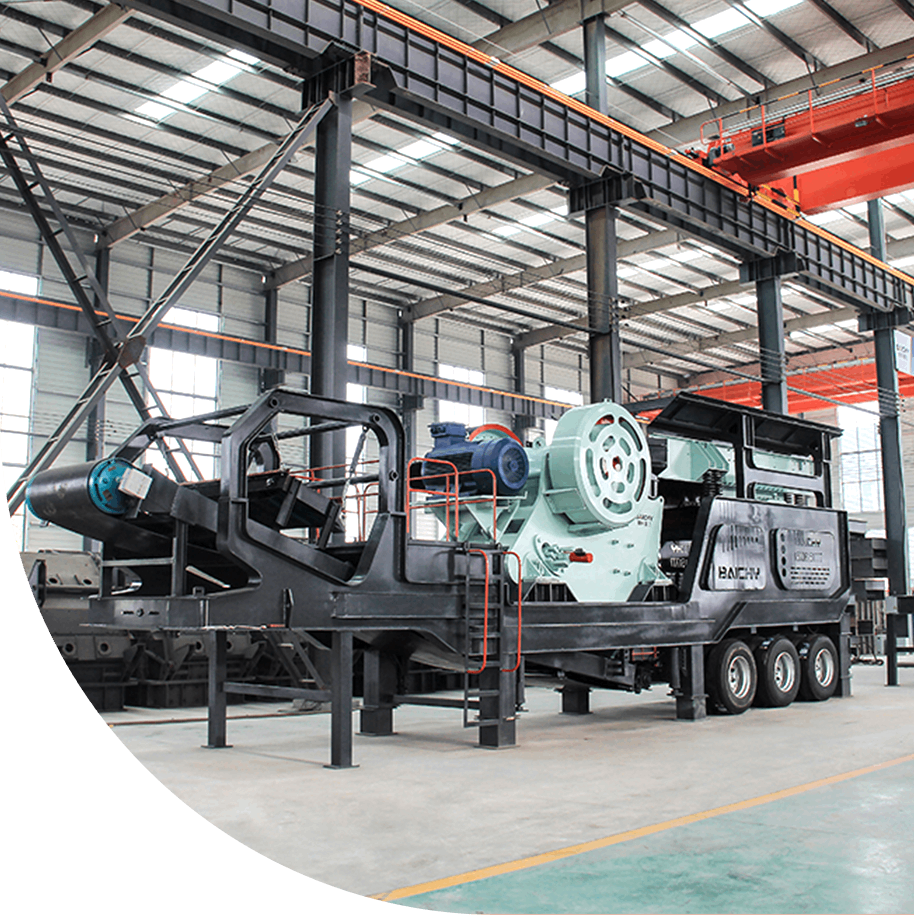
Baichy Mobile Jaw Crusher Finished Goods Workshop