single-drum dryers

High-Efficiency Triple Pass Rotary Drum Dryer
Both triple-pass and single-pass dryers are rotary hot-air drying systems; the fundamental difference lies not in their drying capability, but in the trade-offs regarding spatial footprint and material adaptability. The triple-pass dryer features three concentrically nested cylinders, forcing material to traverse a path three times the length of the unit; this design offers a footprint roughly one-third the size of a single-pass unit and superior thermal efficiency, making it ideal for high-volume, continuous processing of loose, easily dried materials like sand, gravel, slag, and fly ash. Conversely, the single-pass dryer utilizes a single long cylinder with adjustable residence time to handle wet, sticky materials (such as sludge or coal slime) and meet stringent final moisture requirements, albeit at the cost of a larger footprint and higher steel consumption. The consequences of a wrong choice are immediate: using a single-pass dryer for loose materials wastes space and capital, while using a triple-pass dryer for wet, sticky materials leads to clogging and a complete halt in production. Baichy Heavy Industry offers mature production lines for both types and provides free sample drying tests, delivering moisture curves and equipment selection reports within five working days.
I. Overview: A Shared Rotary Drying Technology, pergent Structural Designs
The starting point for dryer selection is not the brand, but rather the material's state upon entering the cylinder and its required moisture content upon exit. Both triple-pass and single-pass dryers rely on cylinder rotation to lift and shower material, creating a "material curtain" for heat exchange with the hot air; the distinction lies in the cylinder geometry:

Structural diagram of a triple-cylinder dryer
• Triple-pass dryer: Three cylinders of progressively smaller diameters are concentrically nested and welded together; material travels sequentially through the inner, middle, and outer cylinders, achieving a greatly extended travel path within a compact overall footprint.

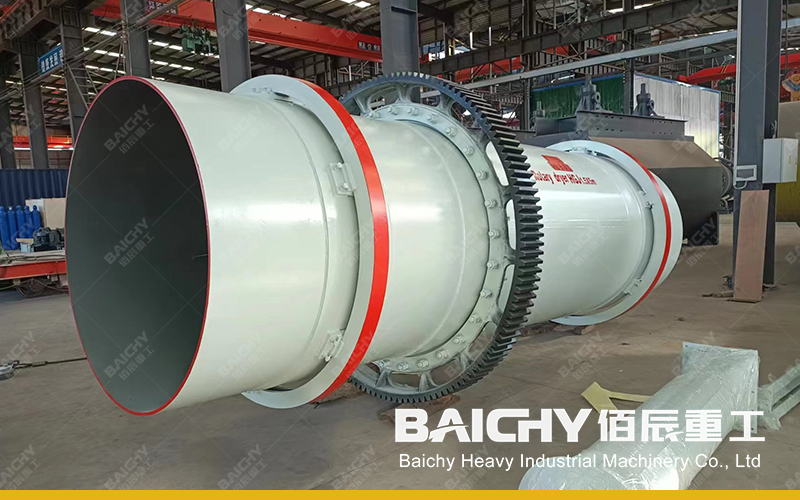
Structural diagram of a single-drum dryer
• Single-pass dryer: A single large-diameter, long cylinder handles the entire drying process; material passes through in a straight line, typically spanning a length of 12–25 meters.
These geometric differences in the travel path dictate five key areas of pergence: footprint, thermal efficiency, residence time, maintainability, and material suitability. Understanding these five differences provides a clear framework for selecting the right dryer.
II. Core Distinctions: A Breakdown of Five Key Differences
1. Structural Design and Footprint
The triple-pass dryer features a nested "Russian doll" structure; its shell length is only about one-third that of a single-pass dryer with equivalent capacity, resulting in a significantly smaller equipment footprint and foundation requirement. It is particularly suitable for production lines with space constraints, indoor installation needs, or requirements for frequent relocation. In contrast, the single-pass dryer has a simple, straightforward structure, but its long cylinder necessitates a wider workshop span and a longer foundation, leading to hidden increases in civil engineering costs.
2. Thermal Efficiency and Heat Loss
In a triple-pass dryer, the outer shell encases the inner and middle cylinders, preventing the high-temperature section from being exposed to the outside. This minimizes surface heat dissipation and reduces heat loss through the exhaust gas and cylinder walls, resulting in an overall thermal efficiency approximately 10 percentage points higher than that of a single-pass dryer under similar operating conditions. Conversely, the single-pass dryer dissipates heat directly from its outer surface to the environment; the effectiveness of cylinder insulation and waste heat recovery systems directly determines the difference in specific fuel consumption.
3. Residence Time and Moisture Control
The core advantage of the single-pass dryer lies in "time": material residence time can reach tens of minutes and is adjustable, making it ideal for materials requiring precise final moisture content or those with slow drying rates. Triple-pass dryers operate on a residence time scale of minutes, focusing on the rapid dewatering of loose materials under high temperatures and high airflow velocities; moisture control relies on the coordination of air temperature and airflow volume, offering less precision than the single-pass type.
4. Material Adaptability and Clogging Risk
This is the most critical factor in equipment selection. Triple-pass dryers have small inner cylinder cross-sections and narrow passages; sticky materials with moisture content exceeding 20–25% easily form clumps and cause blockages in the inner cylinder, which also offers extremely limited space for maintenance. Single-pass dryers feature large cylinder diameters and interchangeable lifter designs; when combined with material-breaking and dry-material back-mixing processes, they can handle sludge filter cakes and wet clay with moisture contents of 55–85%. High-moisture, sticky, and large-particle materials are essentially the "exclusive domain" of single-pass dryers. 5. Investment and Maintenance
Triple-pass dryers offer lower investment costs per unit of capacity and faster installation, but the inner cylinders are prone to wear and difficult to clean, making material changes and cleaning labor-intensive. Single-pass dryers entail higher initial investment and steel consumption but excel in providing ample maintenance space and allowing for rapid replacement of internal components, resulting in more transparent long-term operating costs.
III. Comparison Table of Key Parameters
| Comparison Dimension | Triple-pass Dryer | Single-pass Dryer |
|---|---|---|
| Cylinder Structure | Three concentric nested cylinders; material travels back and forth three times | Single straight cylinder; material passes straight through once |
| Shell Length (for same capacity) | Approx. 1/3 of the single-pass type | Baseline length (12–25m) |
| Footprint & Civil Works | Small; suitable for indoor or compact layouts | Large; requires a workshop with a long span |
| Overall Thermal Efficiency | Relatively high; low surface heat loss | Relies on insulation and waste heat recovery; generally lower |
| Material Residence Time | Short (minutes); limited adjustment range | Long (up to tens of minutes); wide adjustment range |
| Suitable Feed Moisture | ≤20–25%; primarily loose materials | Can handle wet, sticky filter cakes up to 55–85% |
| Final Moisture Control Precision | Moderate; relies on linking air temperature and airflow | High; suitable for precise moisture control |
| Investment per Unit Capacity | Lower | Higher |
| Inner Cylinder Cleaning & Material Change | Difficult; limited maintenance space | Convenient; internal components can be replaced quickly |
| Typical Materials | River sand, quartz sand, slag, fly ash, coal, gypsum | Sludge, coal slime, clay, concentrate, sawdust, and materials requiring long residence times |
Selection Rule of Thumb: Choose triple-pass for loose, low-moisture materials; choose single-pass for sticky, high-moisture materials. Choose triple-pass if space is at a premium; choose single-pass if moisture control requirements are strict.
IV. Application Scenarios: Matching the Right Dryer to the Production Line
Typical Scenarios for Three-Drum Dryers

• Manufactured sand/washed sand lines: Finished sand contains 10–18% moisture and requires drying before truck loading or blending into dry-mix mortar; characterized by high volume, loose material properties, and limited site space—conditions for which the three-drum dryer is ideally suited.
• Deep processing of slag, fly ash, and gypsum: Handling bulk, loose granular materials where residence time is not critical and the primary goal is minimizing heat consumption per ton of material.
• Post-wash drying of coal: Upgrading clean coal or thermal coal with 12–18% moisture; offers distinct efficiency advantages when handling loose material.
Typical Scenarios for Single-Drum Dryers

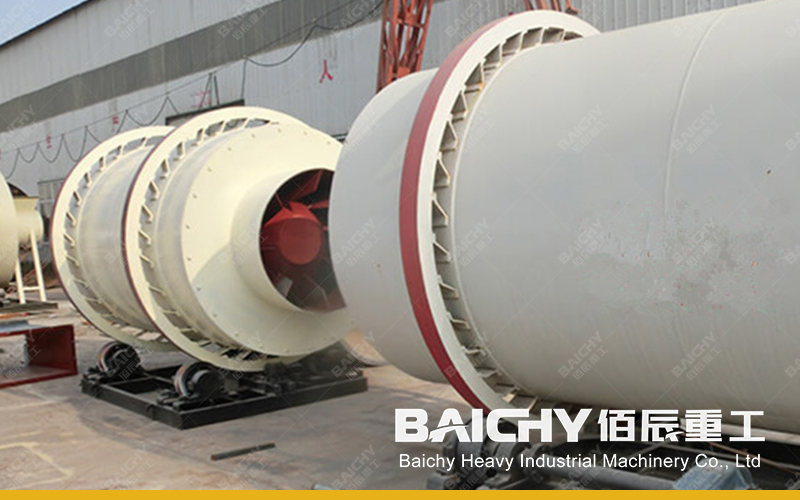
Customer site featuring a single-drum dryer.
• Sludge drying: Municipal or industrial sludge filter cakes with 55–85% moisture; requires material breaking and back-mixing with dry material to ensure continuous operation.
• Wet, sticky materials (coal slime, clay, kaolin, etc.): Moisture content of 25–40% and sticky surfaces; direct feeding into other dryer types causes clogging, making the single-drum design—featuring a large cross-section and replaceable internal components—a prerequisite.
• Downstream materials requiring precise final moisture content: Ceramic raw materials, mineral concentrates, and applications where the output moisture must be controlled within a ±2% range.
V. Application Scenario Comparison Table
| Scenario | Feed Moisture Content | Recommended Model | Reason for Recommendation |
|---|---|---|---|
| Washed sand / quartz sand drying | 10–18% | Triple-pass dryer | Material disperses easily; compact footprint; low heat consumption |
| Slag and fly ash processing | ≤15% | Triple-pass dryer | High-volume continuous processing; focuses on cost-per-ton |
| Clean coal / thermal coal upgrading | 12–18% | Triple-pass or single-pass | Triple-pass for loose material; single-pass for sticky/wet coal types |
| Sludge drying (filter cake) | 55–85% | Single-pass dryer | Requires material breaking & back-mixing; triple-pass is unsuitable |
| Coal slime, wet clay | 25–40% | Single-pass dryer | Large cross-section prevents clogging; adjustable residence time |
| Concentrate / ceramic raw material moisture control | 15–30% | Single-pass dryer | High precision required for final moisture content |
VI. Equipment Advantages: Translating Parameters into Profit
• Triple-pass dryer: Efficiency through compact footprint—saves ~20% on foundation and factory building costs for the same capacity; fuel savings from reduced surface heat loss accrue over the entire lifecycle; ideal for large-scale, standardized production lines (aggregates, slag, etc.).
• Single-pass dryer: Versatility for perse applications—handles everything from 85% moisture sludge to concentrates requiring precise moisture control; compatible with Baichy’s material breaking devices, dry material back-mixing, and explosion-proof safety designs (GB/NFPA/ATEX standards available); one unit handles multiple feed types.
• Hidden value of operational reliability: Triple-pass dryer issues center on inner-cylinder wear and cleaning; single-pass dryer issues center on feed inlet clogging—clarifying "what material will be dried most often over the next five years" is more important than obsessing over current specifications.
• Fuel flexibility: Both models support coal, gas, oil, or biomass hot-air furnaces; choose based on local fuel price differentials; Baichy configures units to local power standards (e.g., 60Hz/400V/380V) prior to shipment.
VII. Application Cases (Anonymized)
1. Washed Sand Drying Line Retrofit (Triple-Drum Selection): A manufactured sand plant in Southeast Asia originally planned an expansion using a single-drum design, but the existing workshop lacked sufficient length, necessitating a new building. By switching to a triple-drum dryer, the equipment length was reduced by approximately 60%, allowing installation within the existing workshop. River sand moisture content was reduced from 15% to ≤1%, and fuel costs per ton dropped by about 18% compared to the original plan.
2. Coal Slurry Upgrading at a Coal Preparation Plant (Single-Drum Selection): A coal preparation plant processed slurry with 30–35% moisture. A triple-drum dryer was previously tested but required weekly cleaning of the inner drum and yielded only 60% of the design capacity. After switching to a single-drum dryer and implementing a 1:0.8 dry material back-mixing ratio, the continuous operation rate exceeded 90%, output moisture stabilized at 14–16%, and annual operating time increased by approximately 600 hours.
3. Alternating Production of Sludge and Clay (Single-Drum Selection): An eco-friendly building materials plant needed to alternately dry sludge and wet clay. A triple-drum dryer required two days for cleaning when switching materials. In contrast, a single-drum dryer allows for switching simply by adjusting the back-mixing ratio and air temperature, keeping downtime for material changes within half a day.
VIII. Recommended Equipment from Baichy Heavy Industry
• Triple-Drum Dryer: A primary choice for high-volume drying of loose materials such as sand, gravel, slag, and fly ash; features a compact structure and high thermal efficiency.
• Single-Drum Dryer: Suitable for wet, sticky materials and applications requiring precise moisture control; supports customization for material breaking, back-mixing, and explosion-proof capabilities.
• Full Series of Rotary Dryers: Includes derivative configurations such as indirect heating and counter-flow models; offers comprehensive system solutions for complex operating conditions.
• Auxiliary Equipment: Hot air furnaces (coal/gas/oil/biomass), cyclone and baghouse dust collection systems, metering feed belts, material breakers/mixers, and back-mixing bins. If you are unsure about model selection, simply send details—such as incoming material moisture content, target moisture levels, required throughput, and site dimensions—to Baichy engineers. We offer free trial drying and provide a moisture curve report within five working days, allowing you to base your decision on data rather than guesswork.
FAQ
Q1: For the same production capacity, how do the footprint and price of a three-drum dryer compare to those of a single-drum dryer?
A: For the same capacity, the shell length of a three-drum dryer is approximately one-third that of a single-drum dryer; this saves about 20% on foundation and facility investment costs and results in a lower price per unit of capacity. However, single-drum dryers do not require frequent drum cleaning when switching materials, so the long-term total cost is not necessarily higher. Final pricing is based on the equipment configuration determined after material trial drying.
Q2: Can high-moisture sludge or coal slime be processed directly in a three-drum dryer?
A: No. The inner drum channels of a three-drum dryer are narrow; materials with over 25% moisture content and sticky surfaces tend to clump and cause blockages in the inner drum, which is difficult to clean. For wet, sticky materials, a single-drum dryer equipped with material-breaking and dry-material back-mixing processes is the standard industry choice.
Q3: If I want to switch to drying a different material after production begins, which type of dryer offers greater flexibility?
A: It depends on the extent of the switch. When switching between loose, free-flowing materials (e.g., from river sand to quartz sand), a three-drum dryer requires only adjustments to airflow temperature and volume. However, if switching from loose materials to wet, sticky materials like sludge or clay, a single-drum dryer is more versatile thanks to its larger drum diameter, replaceable lifting flights, and back-mixing system. We recommend selecting a model based on the material most likely to be processed over the next five years, rather than solely on current operating conditions.

Baichy Heavy Industry
Baichy Heavy Industry is a high-tech mining equipment company integrating R&D, manufacturing, sales, and after-sales service. Focusing on crushing, grinding, and mineral processing equipment, we provide professional solutions to our customers. We are ISO9001:2015 、certified, and our products include mobile crushing palnts, crawler crushing plant, construction waste crushing plants, jaw crushers, sand making machines, cone crushers, fine crushers, grinding mills, ball mills, etc., all with reliable performance to meet diverse project needs.
Baichy Heavy Industry – Your Trusted Partner
To ensure optimal performance of your equipment, Baichy Heavy Industry offers:
- Professional on-site installation guidance
- Comprehensive operator training
- 24/7 technical support & maintenance services
Our complete after-sales service system guarantees long-term, stable operation of your machinery with minimal downtime.
Protect Your Rights – Only Use Official Channels
To avoid scams and ensure authentic support, contact us exclusively through:
• Official Website: www.baichychina.com
• WhatsApp: +8615093222637
• Email: [email protected]
Your satisfaction is our priority – expect prompt, professional service every time.
(Note: Beware of unauthorized third parties claiming to represent Baichy. Always verify through official contacts.)