
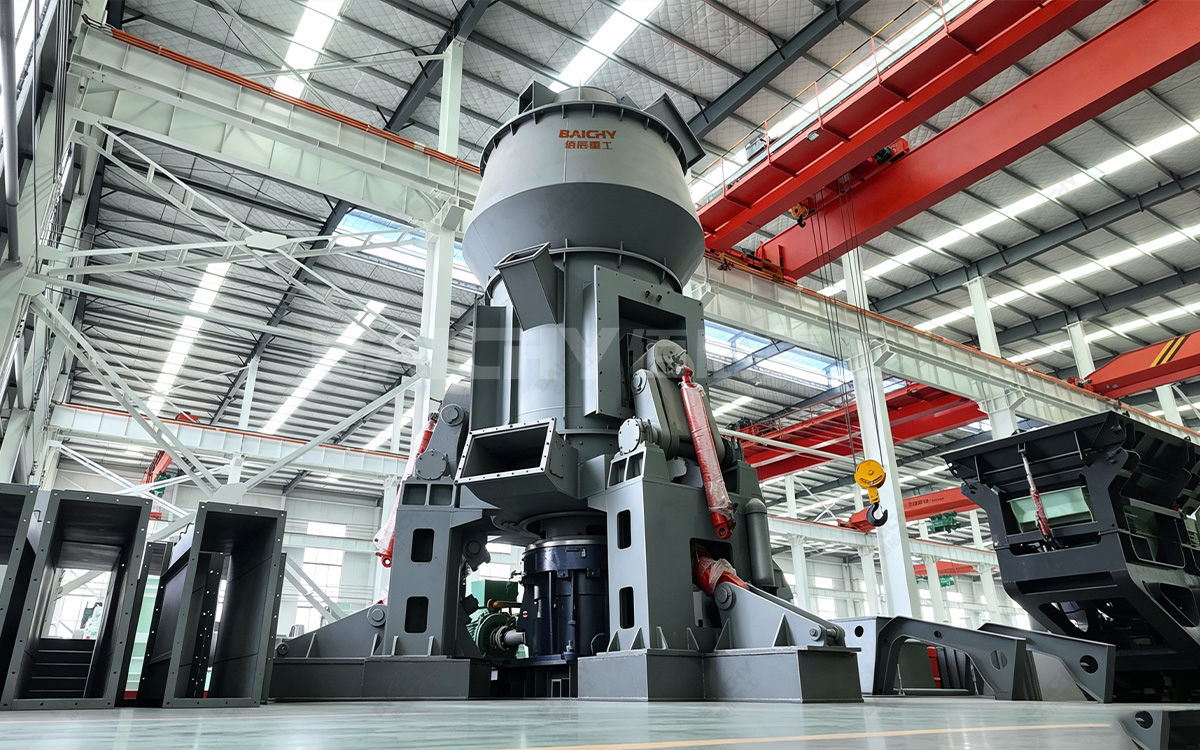
Vertical Mill Equipment for Clinker Grinding
Clinker grinding is the most energy-intensive stage in a cement plant in terms of inpidual equipment power consumption. According to the *USGS Mineral Commodity Summaries (2025)*, global annual cement production is approximately 3.8 billion tons, with grinding systems typically accounting for over 60% of a plant's total electricity consumption. Vertical roller mills (VRMs) for clinker grinding have become the de facto standard for new grinding stations, offering a measured system power consumption of 20–28 kWh/t and energy savings of 25%–40%. However, adopting this technology requires a redesign of control logic—specifically regarding temperature, material bed dynamics, and product fineness—rather than serving as a simple drop-in replacement for ball mills.
If your clinker grinding power consumption exceeds 32 kWh/t, or if you are planning a grinding station with a capacity of 50–200 t/h, the vertical roller mill is worth serious evaluation: for a 100 t/h system operating 8,000 hours annually, a difference of just 1 kWh/t in power consumption translates to an annual electricity cost difference of approximately $64,000. The following sections will help you calculate the payback period by comparing technical parameters, addressing critical process challenges, and outlining selection criteria.
I. Why Clinker Grinding Requires Specialized Equipment Selection
Clinker is the most difficult and "hottest" material to grind.
Directly applying raw meal vertical mill parameters to clinker grinding is a common selection error. Clinker has a significantly higher Bond Work Index and greater abrasiveness than raw meal or limestone. Furthermore, it presents two challenges not encountered with raw meal mills: first, temperature—stored clinker may retain residual heat exceeding 80°C, and excessive grinding heat can compromise cement quality; second, metal contamination—worn iron fragments from grate coolers and crushers can enter the material flow, threatening the grinding rollers and table. Consequently, clinker vertical mills require three features that can be omitted in raw meal mills: an in-mill water spray system interlocked with the mill outlet temperature, pre-mill iron removal and metal detection, and a high-efficiency dynamic separator designed for cement fineness requirements. The primary function of the hot air is temperature control, not drying.
Raw meal and slag contain 8%–15% moisture, requiring the vertical mill's hot air to perform drying; conversely, clinker entering the mill has near-zero moisture, so the hot air primarily serves to transport the pulverized material and dissipate the heat generated during grinding. This distinction directly dictates the airflow velocity within the mill and the selection of the dust collector. Designing the system based on the drying logic used for raw meal mills results in excessively high airflow velocities and wasted energy in fine powder recovery—a common form of hidden waste in clinker grinding projects.
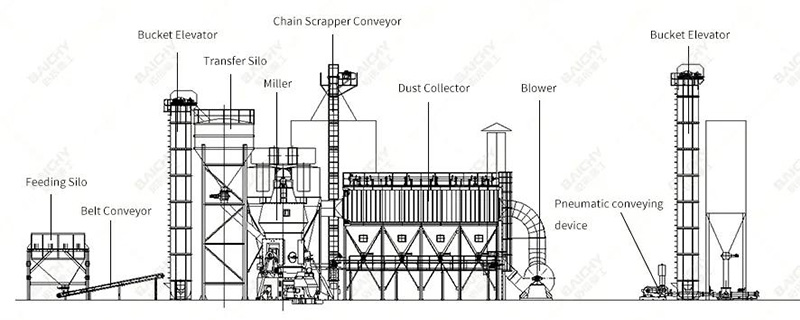
Schematic diagram of the vertical mill process
II. Clinker Grinding Operating Conditions: Vertical Mill vs. Ball Mill
| Comparison Item | Clinker Ball Mill System | Clinker Vertical Mill System |
|---|---|---|
| Grinding Principle | Steel ball impact and grinding | Hydraulic roller-on-bed compression grinding |
| System Power Consumption | 32–38 kWh/t | 20–28 kWh/t |
| Grinding Media | Steel balls (require periodic replenishment) | No media; roller/table lifespan approx. 4,000–6,000 h |
| Fineness Adjustment | Adjusting the classifier or stopping to change settings | Online VFD-controlled classifier; continuous adjustment during operation |
| Temperature Management | Relies on water injection inside the mill | Water injection + interlock with mill outlet temperature; more precise control |
| System Footprint | Large (external separator + multi-stage elevation) | Approx. 1/2–2/3 of the ball mill system |
| Initial Investment | Baseline | Main unit cost is slightly higher, but civil engineering savings make the total price comparable or lower |
Note: Typical industry ranges, not a guarantee for a specific model; particle size distribution and water demand are subject to mill sample tests and physical cement inspections.
The energy savings of vertical mills stem from material bed comminution: energy is used to crush the material rather than to lift and drop steel balls. While ball-milled particles offer better roundness for certain blended cement systems, the power consumption difference of over 20% is a hard economic fact—which is why vertical mills are the default choice for new grinding stations.
III. Three Critical Process Factors for Clinker Vertical Mills
Critical Factor 1: Material Bed Stability and Vibration Control
Vertical mills rely on a stable material bed on the grinding table to cushion the roller pressure: if the bed is too thin, metal-to-metal contact occurs, triggering high-frequency vibration shutdowns; if the bed is too thick, grinding efficiency drops sharply. Due to significant fluctuations in clinker particle size, the feed rate must be precisely measured using a proportioning scale. Process control relies on a "three-loop linkage" strategy: automatic hydraulic pressure compensation based on the material bed, coupling of the separator speed with the feed rate, and vibration-triggered load-reduction protection. Selecting a control system with a proven track record in clinker grinding is far more reliable than simply purchasing a "large vertical mill capable of grinding raw meal."
Critical Factor 2: Temperature Management—Avoiding Gypsum Dehydration and False Set
Dihydrate gypsum in cement acts as a setting regulator; however, if the temperature inside the mill exceeds 110–120°C, it dehydrates into hemihydrate gypsum. This leads to increased water demand and false set, or in severe cases, a regression in strength. Consequently, clinker vertical mills are typically equipped with an in-mill water spray system to maintain the mill outlet temperature between 100°C and 115°C, linked to the hot air temperature. When requesting a quote, ensure the water spray system and its temperature interlock are included in the original equipment configuration rather than added as a retrofit.
Critical Factor 3: Fineness and Particle Size Distribution
For ordinary Portland cement, the target specific surface area (Blaine) is typically 3,200–3,800 cm²/g, corresponding to a 3%–8% residue on a 45 μm sieve. Dynamic separators allow for stepless fineness adjustment during operation, enabling a single production line to switch between different cement grades within minutes. By combining this with grinding aids and external fine-particle recycling, modern clinker vertical mills can tune the particle size range that contributes most to strength (3–32 μm) to levels comparable to those achieved by ball mills.
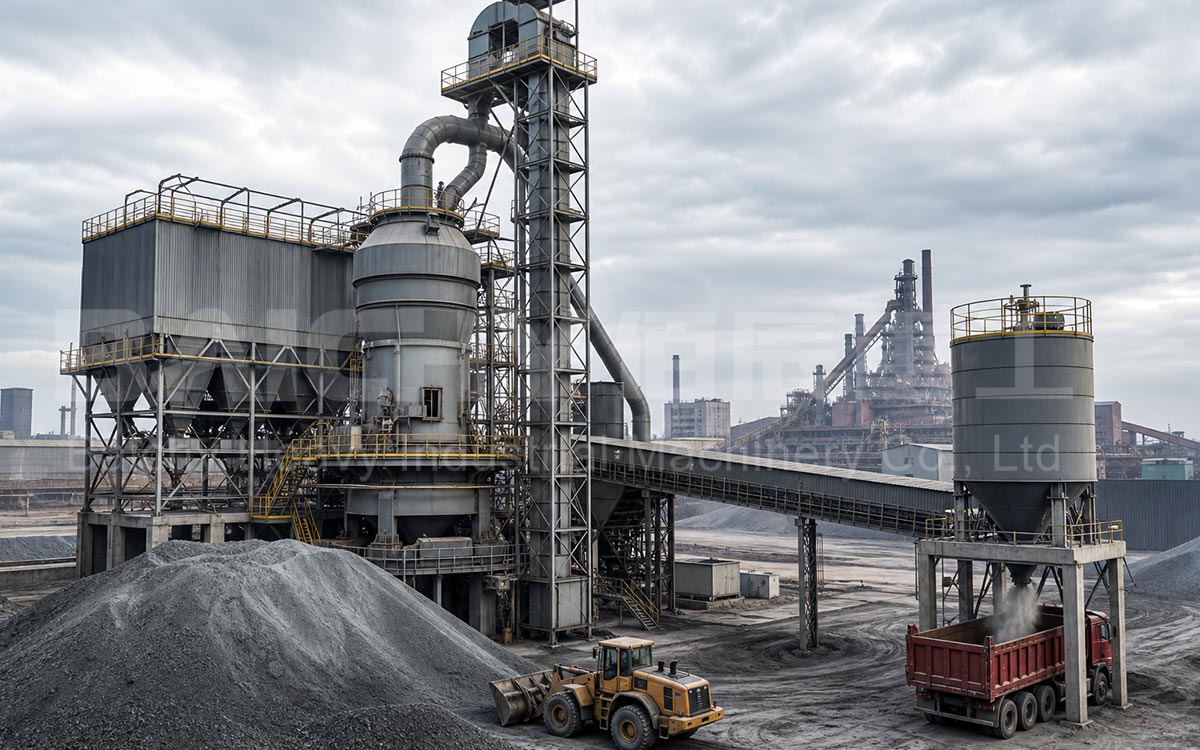
Vertical Mill Customer Site
IV. Core Parameter Table for Vertical Roller Mill (VRM) Clinker Grinding Equipment
| Parameter | Typical Range | Notes |
|---|---|---|
| Application Stage | Final grinding of cement clinker | Also suitable for standalone grinding stations |
| Single-unit Capacity | 40–200+ t/h | Based on 3200–3800 cm²/g fineness |
| Feed Particle Size | ≤ 40–75 mm | Not exceeding approx. 5% of grinding table diameter |
| Feed Moisture Content | ≤ 1% | Hot air handles transport and temperature control |
| Product Fineness | 3200–3800 cm²/g (adjustable to 4000+) | Adjusted via online VFD-controlled classifier |
| Mill Outlet Temperature | 100–115°C (interlocked water spray) | Prevents gypsum dehydration and false set |
| System Power Consumption | 20–28 kWh/t | Includes main motor, fan, and classifier |
| Grinding Component Lifespan | 4000–6000 h | Varies based on abrasiveness and fineness |
| Auxiliary Requirements | Iron remover + metal detector + dosing scale | Protects grinding rollers; ensures stable feeding |
Note: Typical industry ranges; not a guarantee for a specific model. Final specifications depend on material grinding tests and the signed technical agreement.
V. Selection Recommendations
New grinding stations > 50 t/h: Prioritize VRM; total cost (including civil works and system savings) is competitive with ball mills.
Retrofitting existing ball mill lines: Conduct a TCO (Total Cost of Ownership) comparison first; projects with a power consumption difference of 6–10 kWh/t typically have a payback period of 2–4 years.
Frequent switching between cement grades: Online fineness adjustment translates directly into operational flexibility.
Capacity < 30 t/h: For low-capacity scenarios, a ball mill or a combined grinding system (roller press + ball mill) may be more economical.
The essential step before making a decision is sending a 20–50 kg clinker sample for grinding tests to determine the model based on measured output, power consumption, and particle size distribution—this is also the standard procedure for Baichy Heavy Industry's global cement projects.
VI. FAQ
Q1: How fine can a VRM grind clinker? Can it produce high-grade cement?
P·O 42.5–52.5 grades correspond to a fineness of 3200–3800 cm²/g, which is the "sweet spot" for vertical clinker mills; the classifier can be adjusted to 4000–4500 cm²/g to meet early-strength requirements. However, since power consumption and wear rates rise non-linearly with increased fineness, it is recommended to set the baseline according to the target grade.
Q2: How much electricity does a vertical mill save compared to a ball mill for clinker grinding? What is the payback period?
Industry data shows energy savings of 25%–40%. Based on a capacity of 100 t/h and 8,000 operating hours per year: comparing a ball mill (34 kWh/t) to a vertical mill (24 kWh/t) yields annual savings of approximately 8 million kWh. At $0.08/kWh, this equates to roughly $640,000. When combined with savings on grinding media and liner replacements, the price difference for the main equipment is typically recovered within 2–4 years.
Q3: Clinker is hot and hard; will the vertical mill experience frequent vibration-induced shutdowns? How are gypsum-related issues prevented?
Three lines of defense are employed: the hydraulic system automatically compensates based on the material bed and includes vibration-triggered load-reduction protection; the water spray system maintains the mill outlet temperature between 100°C and 115°C to prevent gypsum dehydration and subsequent false set; and pre-mill iron removal combined with metal detection prevents damage to grinding rollers from tramp iron. A prerequisite is that the accuracy of proportioning scales and the design of the buffer bin are clearly specified in the technical agreement.
Baichy Heavy Industry
Baichy Heavy Industry is a high-tech mining equipment company integrating R&D, manufacturing, sales, and after-sales service. Focusing on crushing, grinding, and mineral processing equipment, we provide professional solutions to our customers. We are ISO9001:2015 、certified, and our products include mobile crushing palnts, crawler crushing plant, construction waste crushing plants, jaw crushers, sand making machines, cone crushers, fine crushers, grinding mills, ball mills, etc., all with reliable performance to meet diverse project needs.
Baichy Heavy Industry – Your Trusted Partner
To ensure optimal performance of your equipment, Baichy Heavy Industry offers:
- Professional on-site installation guidance
- Comprehensive operator training
- 24/7 technical support & maintenance services
Our complete after-sales service system guarantees long-term, stable operation of your machinery with minimal downtime.
Protect Your Rights – Only Use Official Channels
To avoid scams and ensure authentic support, contact us exclusively through:
• Official Website: www.baichychina.com
• WhatsApp: +8615093222637
• Email: [email protected]
Your satisfaction is our priority – expect prompt, professional service every time.
(Note: Beware of unauthorized third parties claiming to represent Baichy. Always verify through official contacts.)