+86-15093222637
Contact us for a quote and free process design
Baichy know what you are expecting from mining project and we are making it happen with unrivalled products and services.
Leave Message


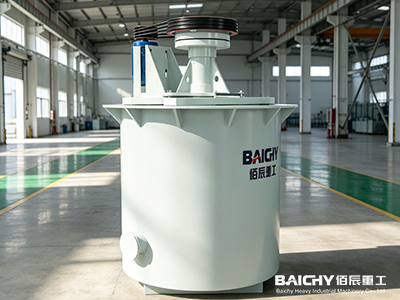
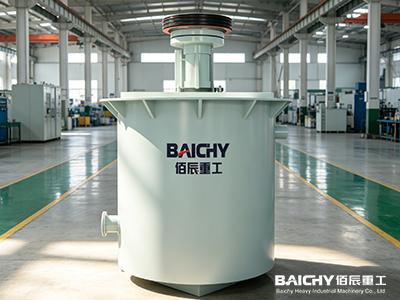
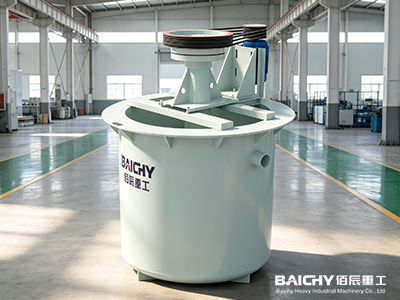
The Mining Agitation Tank (or Agitation Bucket) is a critical auxiliary device in mining beneficiation operations, primarily used to facilitate the forced, uniform mixing of mineral slurry, chemical reagents, and water prior to separation processes (such as flotation).
☛ Contact Us Now To Get A Customized Production Line Configuration Plan.

Mining agitation tanks are primarily utilized to agitate mineral slurries before flotation operations, ensuring thorough mixing and contact between the slurry and chemical reagents, thereby enhancing beneficiation efficiency. Acting as a bridge connecting the grinding and separation stages within a beneficiation production line, these tanks utilize mechanical agitation to create ideal reaction conditions for subsequent beneficiation processes (such as flotation, gravity separation, etc.).
Simply put, their role is akin to that of an industrial-grade "large-scale mixer." Their core functions include:
1. Reagent Activation: Uniformly dispersing beneficiation reagents throughout the mineral slurry, ensuring that every single mineral particle comes into full contact with the reagents.
2. Process Preparation: Creating an optimal chemical and physical reaction environment for subsequent flotation, gravity separation, or leaching processes.
3. Sedimentation Prevention: Maintaining the mineral slurry in a suspended state through the continuous rotation of an impeller, thereby preventing solid particles from accumulating at the bottom of the tank.
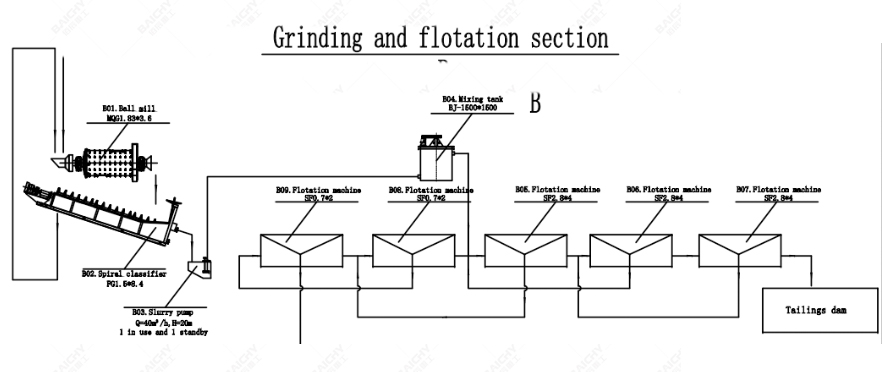
1. Placement: Typically installed downstream of grinding mills and upstream of flotation machines.
2. Scope of Application: Suitable for mineral slurry environments where the solid concentration generally does not exceed 30% and the solid particle size is relatively fine (typically less than 1 mm).
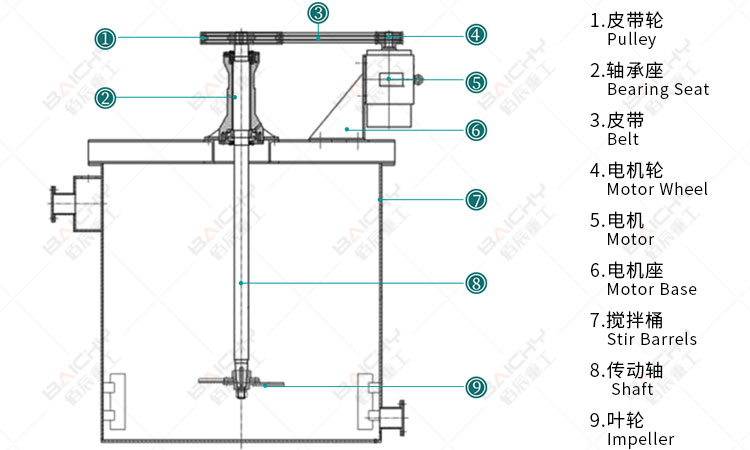
3. Construction: Driven by an electric motor that rotates an impeller; the tank interior is typically equipped with baffles or flow-guiding devices to enhance agitation efficiency and minimize wear.
Equipment for Enhancing Mineral Processing Efficiency
Manufacturer Pricing
Mining Agitation Tanks
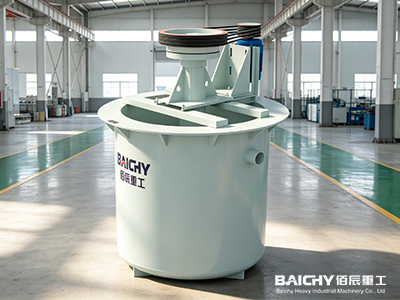
Pre-Flotation Agitation Equipment
Mining agitation tanks are widely employed across the beneficiation processes of various metallic and non-metallic ores:
• Flotation Pre-treatment: This constitutes their primary application. Positioned ahead of flotation machines, they uniformly mix reagents—such as collectors and frothers—with the mineral slurry, ensuring that reagent molecules are fully adsorbed onto the mineral surfaces.
• Reagent Preparation: Used to dissolve, dilute, or mix chemical reagents within the reagent preparation area, thereby ensuring the stability of reagent concentrations.
• Hydrometallurgy (Leaching): In leaching processes, agitation is utilized to accelerate the chemical reaction between the solvent and the valuable minerals.
• Material Mixing: Used in industries such as construction, chemicals, and coal for the forced, uniform mixing of fine-grained materials with liquid media.
Features a patented impeller design with zero dead zones, enabling rapid, microscopic-level integration of reagents and slurry.
Enhances reagent dispersion to drastically lower tailings grades, thereby increasing both production output and revenue.
Optimizes fluid dynamics to slash energy consumption by 40%, while simultaneously reducing reagent costs by 20%.
Critical components are fabricated from imported wear-resistant materials, offering superior resistance to both impact and corrosion to effectively double service life.

Basic Structure: Primarily consists of a motor, reducer, transmission shaft, impeller (agitator), tank body, flow stabilization device, and circulation mechanism.
Working Principle: The motor drives the impeller to rotate via a V-belt transmission, generating a downward thrust or a circulating flow. The impeller thoroughly mixes the reagents with the mineral slurry; simultaneously, the flow stabilization device minimizes swirling, ensuring that the mixed slurry is discharged uniformly.
Applicable Media: Typically suitable for mixing mineral slurries with reagents, specifically for slurries with a concentration (by weight) not exceeding 30%, an ore density not exceeding 3.5 t/m³, and a particle size smaller than 1 mm.

| Model | Internal diameter(mm) | Internal Height(mm) | Volume(m3) | Impeller speed(r/min) | Impeller diameter(mm) | Motor power | Dimension (LxWxH) (mm) | |
| Model | Power(KW) | |||||||
| XB-500 | 500 | 500 | 0.098 | 600 | 200 | Y90S-6 | 1.1 | 600×566×954 |
| XB-750 | 750 | 750 | 0.33 | 530 | 255 | Y90L-4 | 1.5 | 1131×880×1241 |
| XB-1000 | 1000 | 1000 | 0.58 | 350 | 240 | Y90L-4 | 1.5 | 1131×1130×1492 |
| XB-1200 | 1200 | 1200 | 1.18 | 320 | 400 | Y132S-6 | 2.2 | 1500×1480×1800 |
| XB-1500 | 1500 | 1500 | 2.2 | 320 | 400 | Y132S-6 | 3 | 1750×1640×2190 |
| XB-2000 | 2000 | 2000 | 4.4 | 240 | 550 | Y132M2-6 | 5.5 | 2380×2162×2850 |
| XB-2500 | 2500 | 2000 | 9.2 | 272 | 650 | Y160L-6 | 11 | 3036×2716×3543 |
| XB-3000 | 3000 | 3000 | 19.1 | 220 | 700 | Y225S-8 | 18.5 | 3604×3216×4250 |
| XB-3500 | 3500 | 3500 | 30 | 183 | 850 | Y225M-8 | 30 | 3940×3766×5386 |
If you need further information,please fill in your questions and comments in the form below.
Representatives from Baichy machinery will be back to you within the hour,thanking you for your support to Baichy machinery