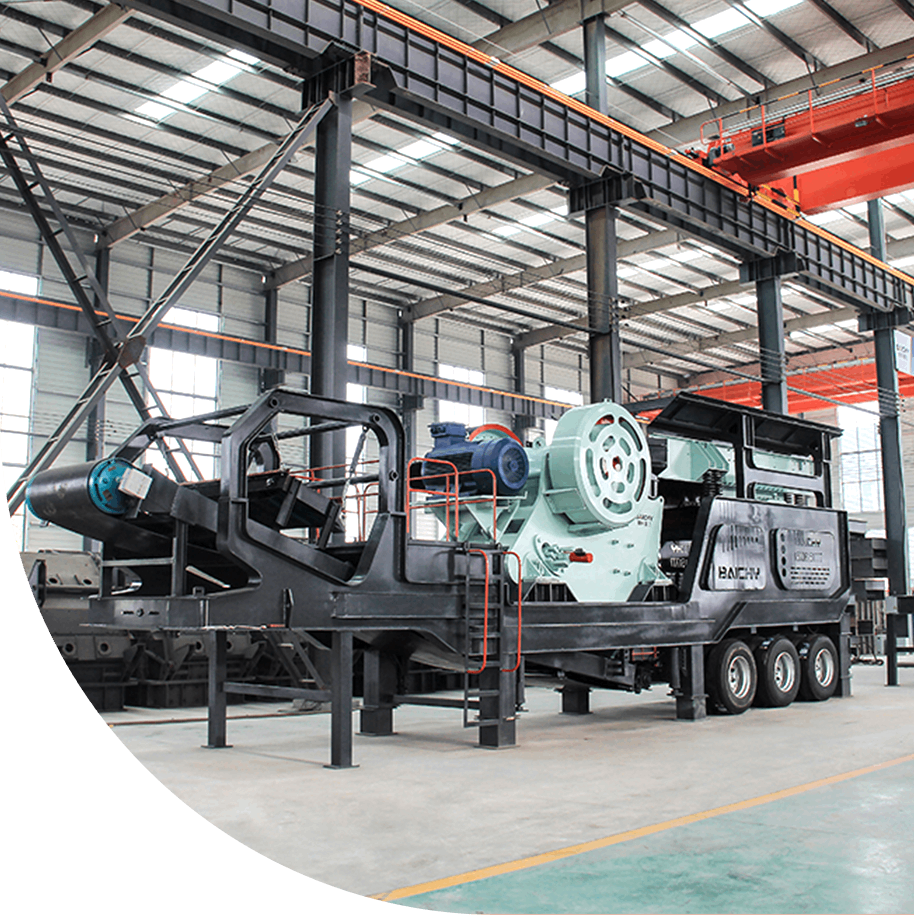

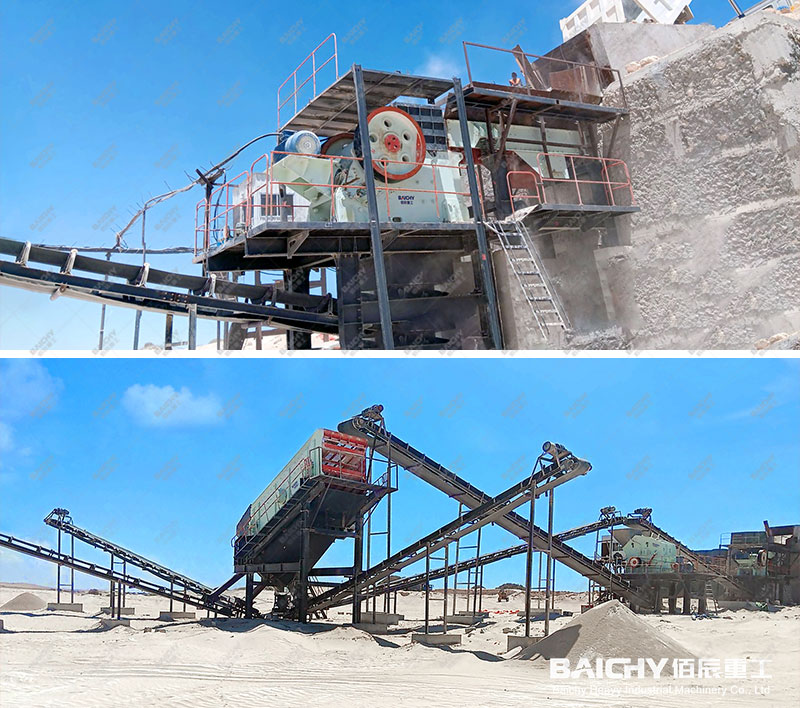
Fixed Stone Crushing Plant
Fixed stone crushing plant is the backbone of large-scale aggregate production. Unlike mobile crushers that move between sites, a fixed stone crusher plant is engineered for permanent installation, higher throughput, lower per-ton operating cost, and decades of reliable service. In this guide, we break down how a fixed stone crushing production line works, the standard configurations, key equipment from Baichy Heavy Industry, capacity selection, and the answers to the questions plant owners ask most.
Why Choose a Fixed Stone Crushing Plant?
Before comparing equipment, you need to understand whether a stationary crushing plant fits your business. The decision between fixed and mobile affects your capital budget, site layout, and long-term cost structure.
Key Advantages of a Fixed Plant
- Higher throughput: A fixed stone crusher plant can be designed for 50 t/h up to 1,000+ t/h, far beyond most mobile units.
- Lower cost per ton: With optimized conveyor routing and permanent foundations, energy and labor costs drop significantly.
- Better product quality: Multi-stage crushing and closed-circuit screening produce consistently shaped aggregates.
- Longer service life: Stationary frames, heavy-duty bases, and dedicated lubrication systems last 20+ years.
- Easier automation: Sensors, PLC control, and centralized monitoring integrate cleanly into a fixed layout.
When Fixed Makes More Sense Than Mobile
Choose a fixed stone crushing production line when your raw material source is stable for many years, when you need consistent aggregate grading, or when environmental and dust-control regulations require a permanent, enclosed setup. Mobile plants suit short-term projects, rented sites, or contractors who relocate frequently.
Core Equipment in a Fixed Stone Crushing Production Line
Every fixed stone crushing plant follows the same logic: feed → primary crushing → secondary crushing → screening → stockpile. Baichy Heavy Industry supplies the complete set with matched capacities.
| Equipment Stage | Typical Model (Baichy) | Feed Size (mm) | Output Size (mm) | Capacity (t/h) | Main Function |
|---|---|---|---|---|---|
| Vibrating Feeder | ZSW-380×96 | ≤500 | — | 96–160 | Even, steady feeding |
| Jaw Crusher (Primary) | PE-750×1060 | ≤630 | 80–140 | 110–320 | Coarse crushing |
| Cone Crusher (Secondary) | PY Series / HP Series | ≤300 | 20–50 | 80–450 | Hard rock medium crushing |
| Impact Crusher (Secondary) | PF-1214 | ≤350 | 20–60 | 80–180 | Soft-medium stone shaping |
| Vibrating Screen | YK Series 3YK2160 | ≤200 | 0–5, 5–15, 15–30 | 60–350 | Multi-grade screening |
| Belt Conveyor | B800–B1200 | — | — | Customized | Material transfer |
| Dust Collector | Pulse Bag Type | — | — | — | Environmental protection |
Primary Crushing: The Jaw Crusher
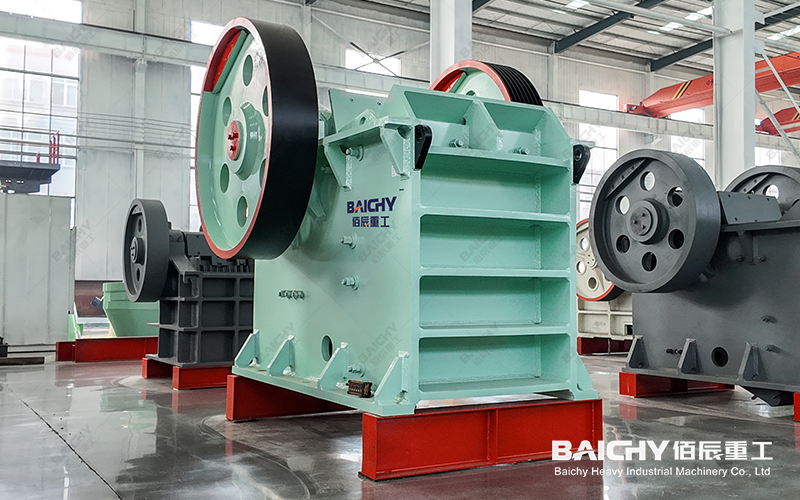
jaw crusher
The jaw crusher is the workhorse that handles the largest feed rocks. For hard stones like granite, basalt, and river pebble, a robust jaw crusher with a high manganese steel jaw plate ensures first-stage reduction to 80–140 mm. Baichy's PE series is engineered for high compression strength and low downtime.
Secondary Crushing: Cone vs. Impact Crusher
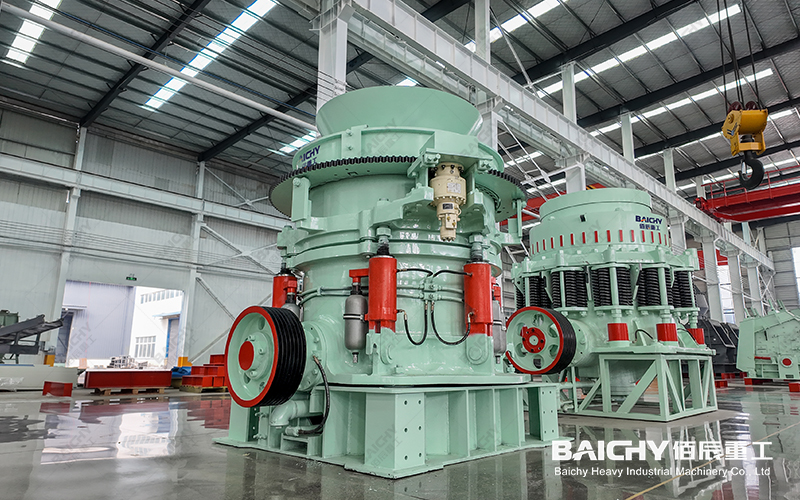
Cone Crusher
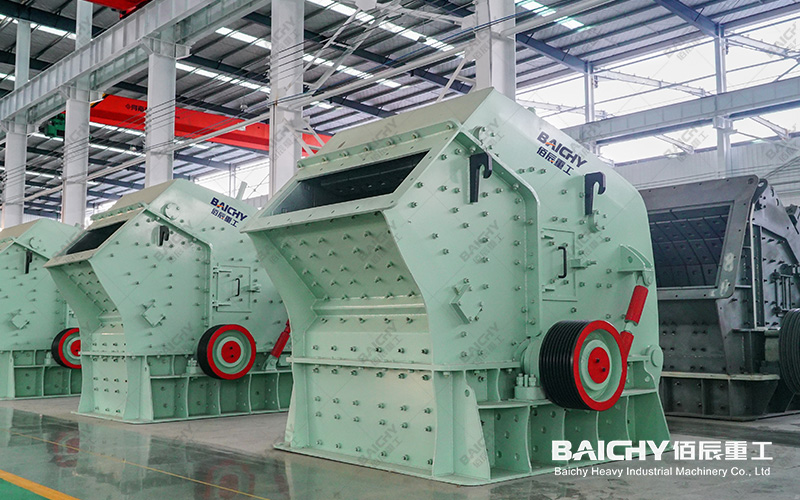
Impact Crusher
Your choice here depends on the stone's hardness:
- Cone crusher is the right pick for hard, abrasive rock (granite, basalt, quartzite). It delivers high reduction ratios and produces cubical, high-quality aggregates with excellent wear resistance.
- Impact crusher suits softer or medium-hard stone (limestone, dolomite, gypsum). It is lower in initial investment, easier to maintain, and shapes the product well.
Many fixed stone crushing plants use a combination — a jaw crusher for primary, then a cone crusher plus an impact crusher for shaping — to maximize both output and particle shape.
Standard Configurations for a Fixed Stone Crushing Plant
Baichy designs layouts around your raw material, target output size, and capacity. Below are the three most common configurations.
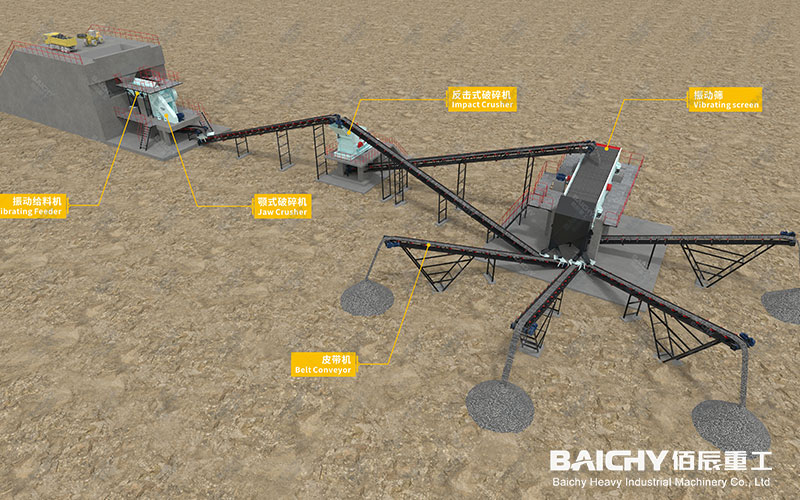
Fixed Stone Crushing Plant
Configuration A: Jaw + Cone (Hard Rock, 100–200 t/h)
Recommended for: granite, basalt, diabase, quartzite.
Flow: Vibrating Feeder → Jaw Crusher → Cone Crusher → Vibrating Screen → finished aggregate. This fixed stone crusher plant produces 0–5, 5–15, and 15–30 mm graded stone ideal for concrete and road base.
Configuration B: Jaw + Impact (Soft Stone, 50–150 t/h)
Recommended for: limestone, dolomite, marble, construction waste.
Flow: Vibrating Feeder → Jaw Crusher → Impact Crusher → Vibrating Screen. Lower operating cost per ton with a compact footprint, perfect for medium-capacity stationary crushing plants.
Configuration C: Multi-Stage Closed Circuit (300+ t/h)
Recommended for: large quarries requiring 100% crushed aggregate with strict grading.
Flow: Feeder → Primary Jaw → Secondary Cone → Tertiary Cone/Impact → double-deck screens with oversize return to crusher. A fully automated, dust-sealed fixed stone crushing production line built for 24/7 operation.
Factors That Decide Your Plant Capacity
Getting capacity right prevents both over-investment and bottlenecking.
1. Raw material hardness and abrasiveness — directly affect crusher selection and liner life.
2. Required output grades — how many aggregate fractions you must produce and their proportions.
3. Hours of operation — a plant running 20 hours/day needs lower peak capacity than one running 8 hours.
4. Waste and fines acceptance — whether 0–5 mm fines are sellable or must be minimized.
5. Budget for energy and maintenance — soft-stone lines save on wear parts but may need more screening.
Work with Baichy's engineers to run a material test before finalizing the fixed stone crushing plant design. Testing avoids buying an oversized crusher or a line that cannot hit spec.
Operating Costs and How to Control Them
The true cost of a fixed stone crushing production line is not the purchase price — it is the lifetime cost per ton.
- Energy: Motors, crushers, and conveyors consume the most. Variable frequency drives and high-efficiency motors cut electricity bills by 10–20%.
- Wear parts: Jaw plates, cone liners, and blow bars are the largest consumables. Choose a crusher with easy-to-replace parts and source genuine Baichy spares.
- Labor: Automation with PLC control and remote monitoring lets 1–2 operators run the whole line safely.
- Maintenance: Scheduled lubrication, screen mesh checks, and belt alignment reduce unplanned downtime dramatically.
A well-designed stationary crushing plant typically pays back its premium over a mobile unit within 2–3 years through lower per-ton cost.
Environmental and Safety Considerations
Modern fixed stone crushing plants must meet increasingly strict dust, noise, and safety standards.
- Dust control: Enclose transfer points, add spray mist systems, and install a pulse bag dust collector at the crushing and screening stages.
- Noise reduction: Use sound barriers around the primary crusher and choose low-noise screens.
- Safety: Emergency stop switches, guard rails, warning signs, and proper electrical grounding are non-negotiable.
- Water recycling: If wet screening is used, a settling tank recirculates process water.
Baichy designs these features into the plant from day one, so your investment is compliant and future-proof.
Why Partner with Baichy Heavy Industry
Baichy Heavy Industry is a professional manufacturer of mining crushing, ore grinding, and mineral processing equipment. For fixed stone crushing plant projects, customers get:
- Complete engineering: site survey, flow design, and layout drawing.
- Matched equipment with verified capacity data, not guesswork.
- After-sales support, genuine spare parts, and commissioning teams.
- Proven installations across granite, limestone, basalt, and river pebble projects worldwide.
Whether you are upgrading an existing fixed stone crusher plant or building from scratch, Baichy's team delivers a cost-effective, reliable, and fully automated stone crushing production line tailored to your quarry.
Conclusion
A fixed stone crushing plant is the right long-term investment for stable, high-volume aggregate production. By choosing the correct configuration — jaw-plus-cone for hard rock, jaw-plus-impact for soft stone, and closed-circuit screening for quality grading — you optimize cost per ton and product quality. Partner with a professional manufacturer like Baichy Heavy Industry to design, build, and support a fixed stone crushing production line that runs profitably for decades.
FAQ
1. What is a fixed stone crushing plant?
A fixed stone crushing plant is a permanent, stationary setup of vibrating feeder, jaw crusher, cone or impact crusher, vibrating screen, and belt conveyors, installed on a fixed foundation to process rock into graded aggregates at high, consistent capacity over many years.
2. What is the difference between a fixed and a mobile crushing plant?
A fixed plant is installed permanently for high throughput, lower cost per ton, and better product quality, while a mobile plant moves between sites and suits short-term or relocating projects. Fixed plants are the better investment for long-term quarries.
3. Which crusher should I choose for granite, jaw or cone?
For hard rocks like granite, use a jaw crusher for primary crushing and a cone crusher for secondary. This combination handles high compression strength and produces cubical, high-quality aggregates with low wear-part costs.
4. How do I determine the right capacity for my stone crushing production line?
Consider your raw material hardness, required output grades, daily operating hours, acceptable fines, and energy budget. Run a material test with the manufacturer so the line is sized correctly and avoids both over-investment and bottlenecking.
5. How can I reduce dust and noise in a fixed crushing plant?
Enclose transfer points, install spray mist systems and a pulse bag dust collector, use sound barriers around the primary crusher, and add water recycling for wet screening. These measures ensure compliance and protect operator safety.
Baichy Heavy Industry
Baichy Heavy Industry is a high-tech mining equipment company integrating R&D, manufacturing, sales, and after-sales service. Focusing on crushing, grinding, and mineral processing equipment, we provide professional solutions to our customers. We are ISO9001:2015 、certified, and our products include mobile crushing palnts, crawler crushing plant, construction waste crushing plants, jaw crushers, sand making machines, cone crushers, fine crushers, grinding mills, ball mills, etc., all with reliable performance to meet diverse project needs.
Baichy Heavy Industry – Your Trusted Partner
To ensure optimal performance of your equipment, Baichy Heavy Industry offers:
- Professional on-site installation guidance
- Comprehensive operator training
- 24/7 technical support & maintenance services
Our complete after-sales service system guarantees long-term, stable operation of your machinery with minimal downtime.
Protect Your Rights – Only Use Official Channels
To avoid scams and ensure authentic support, contact us exclusively through:
• Official Website: www.baichychina.com
• WhatsApp: +8615093222637
• Email: [email protected]
Your satisfaction is our priority – expect prompt, professional service every time.
(Note: Beware of unauthorized third parties claiming to represent Baichy. Always verify through official contacts.)